Can U.S. Artists Copyright Works Made With Generative AI?
Generative artificial intelligence has made it possible for artists to create images, music, video, and written material in seconds. That speed has also created a difficult legal question: can an artist claim copyright in a work made with generative AI?
Under current U.S. law, the answer depends on what the human artist actually contributed. A work produced entirely by an AI system, with no protectable human authorship in the final expression, cannot receive copyright protection. However, an artist may own copyright in original human-created elements, including creative edits, additions, selections, arrangements, or transformations incorporated into a larger AI-assisted work. Copyright can therefore protect some AI-assisted projects, but it does not automatically cover every component generated by a machine.
This distinction matters for painters, illustrators, photographers, designers, filmmakers, musicians, authors, and creative businesses. It affects whether a work can be registered, licensed, sold with meaningful exclusivity, and enforced against copying. Artists who understand the human-authorship rule can structure their process more deliberately and avoid promising rights they may not own.
The Short Answer Under U.S. Copyright Law
Copyright protects “original works of authorship” fixed in a tangible medium. Courts and the U.S. Copyright Office have long interpreted authorship to require a human creator. An AI model is not a legal author under the Copyright Act, and a person does not become the author of every output merely by owning the computer, operating the software, or requesting a result.
The U.S. Copyright Office explained this position in its 2025 report on copyrightability and artificial intelligence. The Office concluded that existing law is capable of addressing AI-assisted works and that copyright remains available when a human determines sufficient expressive elements of the finished work. It also found that purely AI-generated material is not protected.
The key inquiry is not whether AI appeared somewhere in the workflow. Many artists use sophisticated tools, from digital cameras and editing software to synthesizers and computer-assisted design programs. The important issue is whether a human exercised creative control over copyrightable expression. If the software functions as an assisting tool and the artist determines the protected expression, copyright may arise. If the system determines the expressive details and the person merely accepts the result, those details may remain outside copyright.
Why Human Authorship Is the Central Requirement
Copyright law rewards human creative expression rather than ideas, methods, systems, or machine activity. A copyright claimant must identify a human author whose choices produced the original expression being claimed. Creativity does not have to be groundbreaking. The threshold is low, but there must still be at least a minimal amount of human creative authorship.
This rule was reinforced in Thaler v. Perlmutter. Stephen Thaler sought to register an image that he said was autonomously created by an AI system, listing the machine as the author and claiming ownership through the machine. The U.S. Copyright Office refused registration, and the U.S. Court of Appeals for the District of Columbia Circuit upheld that result in March 2025. The court held that the Copyright Act requires human authorship. In March 2026, the U.S. Supreme Court denied the petition seeking review.
A denial of Supreme Court review is not itself a ruling on the merits and should not be described as a nationwide Supreme Court holding. It left the D.C. Circuit judgment in place, however, and the Copyright Office continues to apply the human-authorship requirement when examining registrations.
For most artists, the practical lesson is straightforward. Calling a machine a co-creator, buying a subscription, or directing a model to make an image does not by itself establish copyright. The artist must be able to point to original expression that the artist—not the system—actually created.
Are Text Prompts Enough to Claim Copyright?
Text prompts can involve imagination, experimentation, and skill. An artist might spend hours testing descriptions, negative prompts, reference settings, seeds, and parameters. Even so, the Copyright Office’s current position is that prompts alone generally do not provide enough human control over the expressive elements of a conventional generative AI output.
A prompt often communicates instructions, ideas, or desired attributes. The model then determines the precise shapes, colors, lighting, textures, composition, and other details. The same prompt may also produce different results on repeated runs. That gap between the user’s request and the system’s execution makes ordinary prompting different from directly drawing, photographing, composing, or writing the resulting expression.
This does not mean prompts are valueless or that they can never contain protectable language. A sufficiently original written prompt may itself qualify as a literary work, just as other original text can. But copyright in the wording of a prompt does not automatically extend to the image or music that the model generates in response. The prompt and output are legally distinct works.
The analysis could differ when a system gives a person much tighter control over the output. For example, an artist might use selection tools, control maps, detailed drawing inputs, or other features that allow the artist to determine particular expressive elements. The legal question would then focus on which elements reflect human choices and whether those choices are visible in the final work. There is no universal number of prompts or hours that guarantees protection.
When an AI-Assisted Artwork May Be Copyrightable
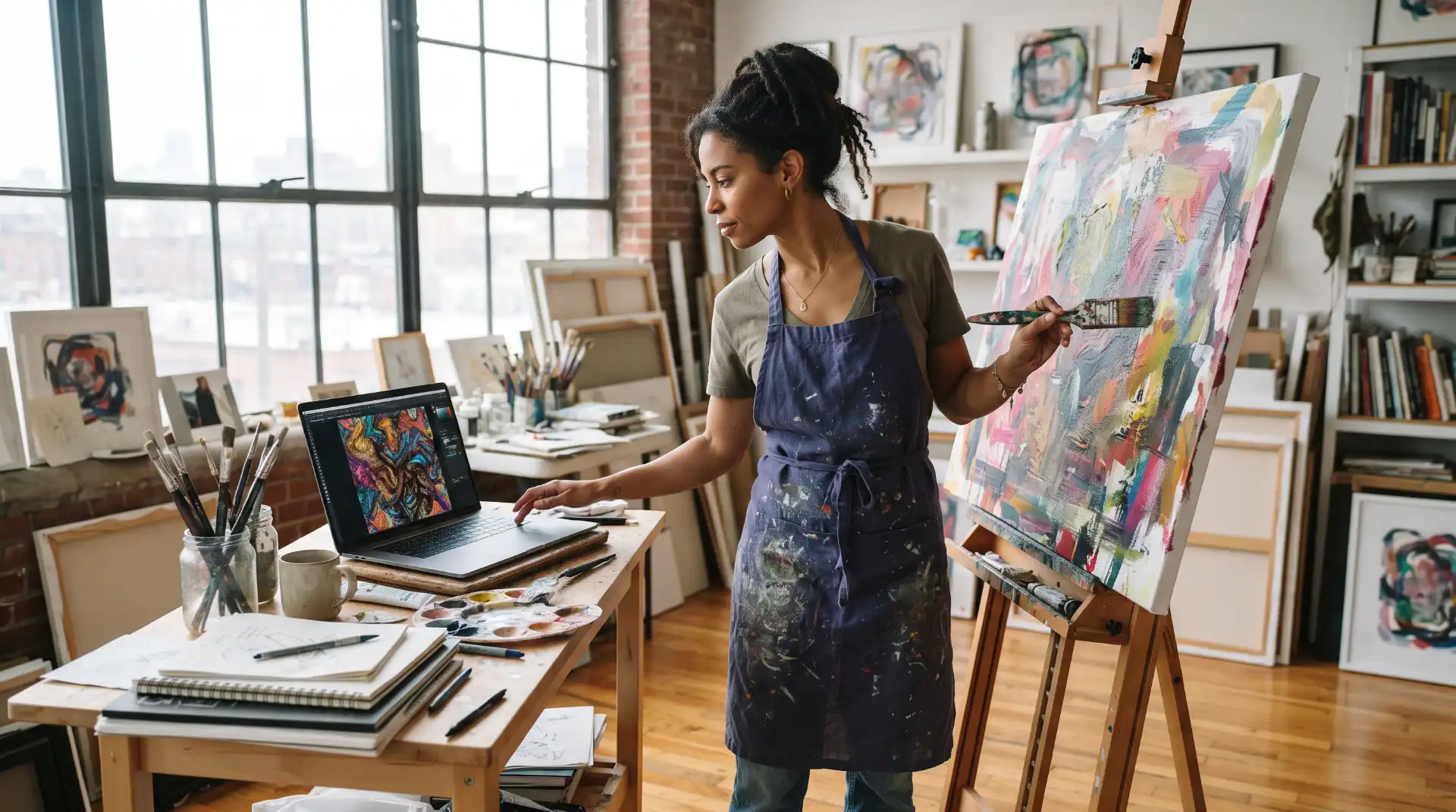
An artist can potentially claim copyright when generative AI is part of a broader human-directed process. The claim is limited to the human-authored expression. Depending on the facts, that expression may include hand-drawn or photographed material, substantial revisions to an output, original text, or the creative selection and arrangement of multiple elements.
Consider an illustrator who generates a background, paints new characters by hand, changes the lighting, redraws architectural features, and combines the result with original typography. The untouched AI background may be excluded from protection, while the illustrator’s characters, modifications, text, and qualifying arrangement may be protected. Someone copying only an unprotected AI-generated fragment might not infringe the illustrator’s copyright, while copying the complete human-authored composition could raise a different issue.
A photographer could use generative fill to expand a small edge of a human-authored photograph. Copyright would ordinarily remain in the photograph’s protectable human expression, although the generated extension may need to be disclaimed in a registration. A filmmaker might combine AI-generated effects with human-shot footage, editing, dialogue, music, and sequencing. The human-created parts and original overall arrangement can qualify even if the machine-generated effects do not.
The Copyright Office has also recognized claims in the selection, coordination, and arrangement of AI-generated material when those choices reflect sufficient human creativity. That protection can be narrow. It covers the artist’s original way of selecting and arranging content, not necessarily each individual AI-generated item within the compilation.
Selection and Arrangement Are Not Ownership of Every Element
This distinction is familiar in copyright law. A collage, anthology, website, or catalog may contain public-domain or separately owned material while still receiving protection for its original organization. The compiler cannot prevent others from using the underlying unprotected material, but may be able to stop copying of the compiler’s original expressive arrangement.
The same principle can apply to generative AI projects. A graphic novelist may select generated images, place panels, write dialogue, design pacing, and build an original narrative. Copyright may cover the human-authored text and the selection and arrangement of the pages even if the generated images themselves are excluded. In the Zarya of the Dawn registration matter, the Copyright Office recognized protection for the human-authored text and the selection, coordination, and arrangement of the work, but not for images generated by Midjourney.
Artists should therefore avoid treating a registration for a compilation as proof that all underlying material is protected. The registration certificate and deposit materials must be read carefully. A limited claim can still be commercially useful, but its scope should be described accurately in licenses and enforcement notices.
How Much Human Editing Is Enough?
There is no fixed percentage, layer count, or editing time that makes an AI-generated work copyrightable. Courts and the Copyright Office examine the specific human contribution. Merely changing resolution, applying an automatic filter, correcting a minor artifact, or making other mechanical adjustments may not add enough original authorship. More extensive creative changes may qualify when they reflect the artist’s own expression.
Useful evidence may include before-and-after files, saved layers, sketches, screen recordings, edit histories, and notes explaining the artist’s decisions. These records do not create copyright by themselves, but they can help identify what the human contributed. A flattened final image may conceal hundreds of deliberate edits, while a visually impressive output may have required only a short request and no expressive human revision.
The inquiry is qualitative, not simply quantitative. A small but highly original human addition may receive protection, although the copyright would extend only to that addition. A large amount of labor that consists of repeated prompting or technical cleanup may still fail to produce protectable human expression. Copyright does not reward effort alone.
How Artists Should Register AI-Assisted Works
Copyright exists automatically when qualifying human-authored expression is created and fixed, but registration provides important enforcement benefits. For U.S. works, registration or refusal is generally required before filing an infringement lawsuit. Timely registration may also preserve eligibility for statutory damages and attorney’s fees, subject to the Copyright Act’s requirements.
An applicant should identify the human author and accurately describe the human-authored material. If the work contains more than a minimal amount of AI-generated content, the applicant generally should exclude that content from the claim. The Copyright Office’s registration guidance for works containing AI-generated material explains how applicants can disclose and disclaim material that is not human-authored.
For example, an applicant might claim “text, original artwork, and selection and arrangement” while excluding “AI-generated images.” The correct description depends on the actual project. Artists should not list an AI system as an author or assume that naming the software in a notes field solves the issue. The application must distinguish the protected human contribution from excluded material.
Artists who already obtained a registration without disclosing substantial AI-generated content should not simply ignore the problem. The Copyright Office advises registrants to take steps to correct the public record, which may involve a supplementary registration. A material omission can complicate enforcement and may expose the registration to challenge.
What Copyright Does—and Does Not—Protect
Even when an AI-assisted work qualifies for copyright, protection does not cover its general idea, style, method, or subject matter. An artist generally cannot use copyright to own the concept of “a futuristic city painted in pastel colors” or prevent everyone from creating work in a broad artistic style. Copyright instead protects the artist’s particular original expression.
This limitation is important when an AI tool creates outputs that resemble a recognizable genre or aesthetic. A similar mood, technique, or style is not automatically infringement. The analysis usually asks whether protectable expression from a particular copyrighted work was copied. Other legal theories, such as trademark, right of publicity, contract, or unfair competition, may apply in some circumstances, but they have different requirements and vary by jurisdiction.
Copyrightability of an output is also separate from whether training or generating that output infringes someone else’s work. An artist might own copyright in human-authored edits while still facing a claim that an incorporated element copied protected expression. Conversely, a purely generated output might be unprotectable even if its creation did not infringe any third-party copyright. Ownership and infringement should be evaluated separately.
Commercial Risks When Selling AI-Assisted Art
Artists and creative businesses should review the terms of the AI platform they use. A provider may assign whatever rights it has in an output, but a contract cannot manufacture federal copyright in material that lacks human authorship. Platform terms may also grant the provider licenses, limit warranties, restrict particular uses, or require the user to address third-party claims.
Client agreements should state whether AI was used and identify which rights are being transferred or licensed. A promise that a client will receive “exclusive ownership of all artwork” may be risky if much of the deliverable is uncopyrightable or subject to platform terms. The contract can address ownership of human-created source files, confidentiality, permitted uses, revision rights, and responsibility for legal review.
Marketplace rules add another layer. Stock-image sites, publishers, galleries, contests, and print-on-demand services may impose disclosure requirements that go beyond copyright law. Violating those rules can lead to removal or account action even when the work is lawful. Artists should preserve the version of the applicable terms in effect when a project is created.
A Practical Workflow for Protecting Human Contributions
Artists can reduce uncertainty by treating documentation as part of the creative process. Keep original sketches, photographs, recordings, drafts, and project files. Save generated outputs separately from later human edits, and retain layered files that show which elements were redrawn, rearranged, or added. Documenting model names, dates, settings, and major prompts can also help reconstruct the workflow.
Before publication, identify the elements that came from the artist and those generated by the system. Ask whether the human choices appear in the finished expression or merely describe a desired result. If the work will be commercially important, consider adding substantial original material rather than relying on prompting alone.
Registration should match that honest assessment. Claim the human-authored components and disclaim substantial AI-generated material. Contracts, copyright notices, licensing pages, and marketing claims should reflect the same boundaries. Consistency can prevent a creator from asserting broad ownership in public while describing a much narrower claim to the Copyright Office.
For a high-value campaign, book, film, game, album, or licensing portfolio, an intellectual property attorney can review the workflow and registration strategy. Legal advice is particularly useful when multiple contributors, custom models, commissioned assets, confidential materials, or third-party reference works are involved.
Will Congress Change the Law?
Congress could amend the Copyright Act, but current federal law does not create a separate copyright for autonomous AI outputs. The Copyright Office’s 2025 report concluded that a new form of protection was not then justified and that existing doctrine could accommodate works created with AI assistance. Policy debates continue over incentives, competition, training data, attribution, and the economic effect of unprotected outputs.
Artists should monitor future legislation and court decisions, but they should not assume that anticipated reform grants rights today. State laws and contracts may regulate particular uses of synthetic media, yet they do not replace federal copyright protection. For present projects, human authorship remains the foundation of a valid U.S. copyright claim.
Frequently Asked Questions
Can I copyright an image if I wrote a very detailed prompt?
Not automatically. Under current Copyright Office policy, prompting alone generally does not provide sufficient control over the output’s expressive elements. Copyright may protect original wording in the prompt itself, but that protection does not necessarily cover the resulting image.
Do I own an AI image because I paid for the software?
Payment may affect contractual rights under the platform’s terms, but it does not establish human authorship. A provider can transfer its contractual interest, yet neither party can create federal copyright in a purely machine-generated work merely by agreement.
Can I copyright an AI image after editing it?
You may be able to protect original human-authored edits if they contain sufficient creativity. Protection ordinarily covers those edits and possibly an original selection or arrangement, not every untouched AI-generated element.
Must I disclose AI use in a copyright application?
If a work contains more than a minimal amount of AI-generated material, the applicant should disclose and exclude that material as directed by the Copyright Office. Incidental AI assistance that does not generate expressive material may not require a disclaimer, but the facts of the workflow matter.
Can someone freely copy my entire AI-assisted work?
Not necessarily. Even if some elements are unprotected, the work may contain copyrightable human text, artwork, editing, or arrangement. Whether copying infringes depends on what was taken and the scope of the human-authored expression.
The Bottom Line
Artists can copyright qualifying human contributions to works created with generative AI, but they cannot claim copyright merely because they prompted, selected, or paid for a machine-generated output. The strongest claims arise when the artist controls and creates identifiable expressive elements through original drawing, writing, photography, performance, editing, or creative arrangement.
The safest approach is to document the creative process, separate human and generated material, register the claim accurately, and describe the scope of ownership honestly in commercial agreements. Generative AI can be a powerful artistic tool, but under current U.S. law, copyright still begins with human authorship.
This article provides general information about U.S. copyright law and does not constitute legal advice. Copyright outcomes depend on the facts of each work and may change as courts, Congress, and the U.S. Copyright Office address new technologies.