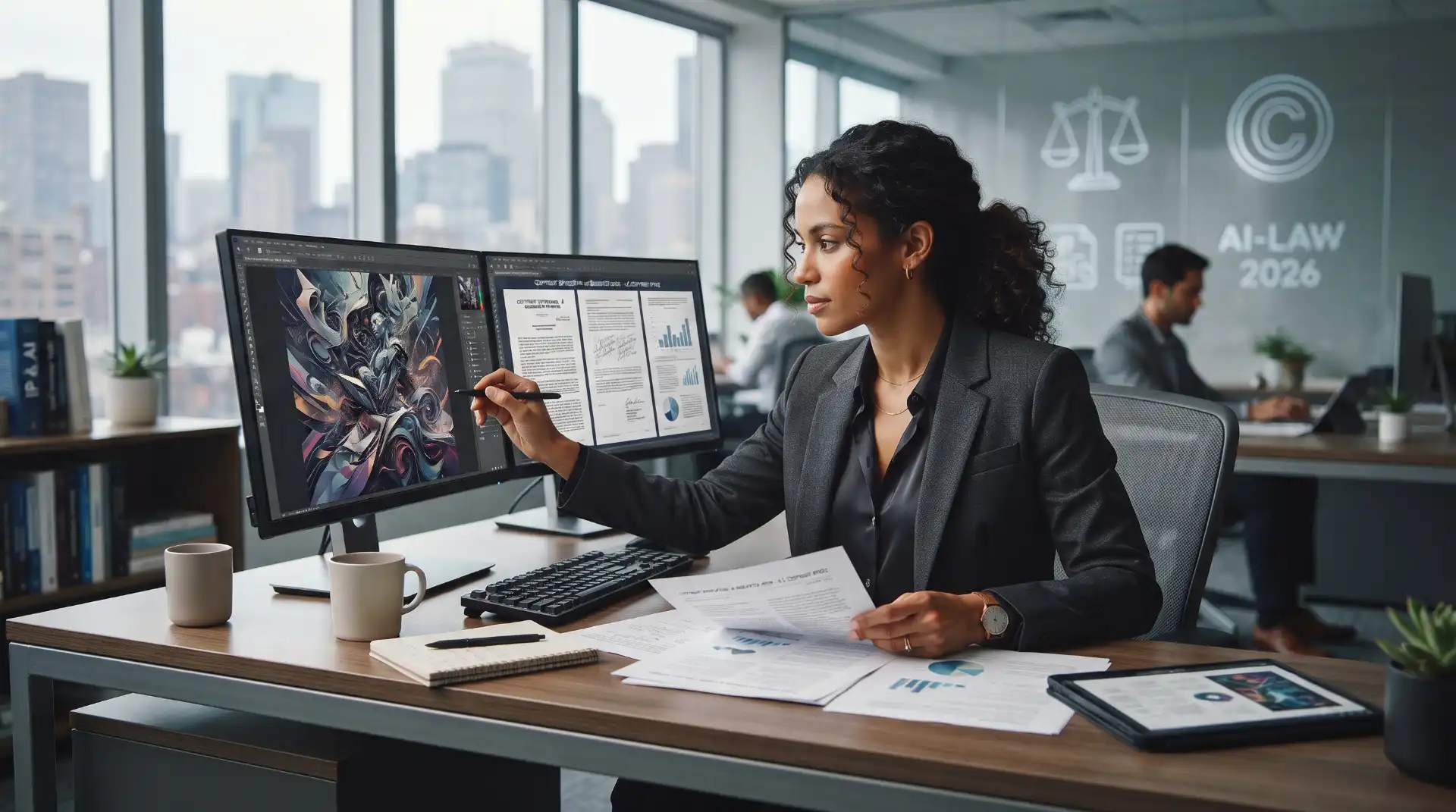
AI Copyright After Thaler: Why Human Authorship Still Matters in 2026
Artificial intelligence can now generate illustrations, songs, videos, software, advertising copy, photographs that never existed, and entire fictional worlds from relatively short instructions. The technology has advanced so quickly that an increasingly important legal question is no longer whether AI can produce creative-looking material. It clearly can.
The harder question is whether that material can be copyrighted in the United States.
In 2026, the answer continues to revolve around one fundamental principle: copyright protects human authorship.
That principle became especially important after Thaler v. Perlmutter, the closely watched dispute involving computer scientist Stephen Thaler and an image generated by his artificial intelligence system. The litigation eventually reached the U.S. Court of Appeals for the District of Columbia Circuit, which held in March 2025 that the Copyright Act requires an eligible work to be authored in the first instance by a human being.
Thaler subsequently asked the U.S. Supreme Court to review the case. On March 2, 2026, the Supreme Court denied his petition for certiorari. That denial did not create a new Supreme Court precedent or represent a decision on the merits. It did, however, leave the D.C. Circuit’s judgment in place.
For artists, writers, developers, designers, photographers, filmmakers, publishers, businesses, and other creators using generative AI, the practical significance is considerable.
The important question is increasingly not simply, “Was AI used?”
Instead, creators need to ask: What part of this work did a human actually author?
How Thaler Became a Landmark AI Copyright Case
The Thaler dispute began with an artwork titled A Recent Entrance to Paradise. Stephen Thaler sought copyright registration for the image and identified an artificial intelligence system called the Creativity Machine as its author.
That detail was crucial.
Thaler was not initially asking the Copyright Office to treat the image as a human-authored work merely created with technological assistance. He represented the work as having been autonomously generated by a machine.
The U.S. Copyright Office refused registration.
Thaler challenged that decision in federal court, but the district court upheld the Copyright Office’s position. The dispute eventually reached the U.S. Court of Appeals for the D.C. Circuit.
On March 18, 2025, the appellate court affirmed the refusal to register the work.
The court interpreted the Copyright Act’s references to an “author” and “authorship” as referring to human beings. It concluded that the Creativity Machine could not qualify as the author of a copyrighted work because copyrightable works must originate with human authors.
The court also rejected Thaler’s attempt to rely on the work-made-for-hire doctrine.
Work made for hire can allow an employer or commissioning party, under specific statutory circumstances, to be treated as the copyright owner or author for legal purposes. But it does not eliminate the underlying authorship requirement. The D.C. Circuit explained that a copyrightable work must still have been created initially through human authorship.
That distinction matters because some AI businesses have suggested that ownership rules could solve the machine-authorship problem.
Thaler indicates that ownership and authorship are different questions.
Before determining who owns a copyright, there must first be copyrightable authorship.
What Happened at the Supreme Court in 2026?
After losing before the D.C. Circuit and being denied rehearing, Thaler petitioned the Supreme Court.
The case was docketed as Stephen Thaler v. Shira Perlmutter, No. 25-449.
The Supreme Court denied the petition on March 2, 2026.
It is important to describe that procedural event accurately.
A denial of certiorari does not mean that the Supreme Court formally adopted every part of the D.C. Circuit’s reasoning. The Court did not issue an opinion declaring that the Constitution or Copyright Act independently requires human authorship.
Instead, the Supreme Court declined to hear the case.
As a result, the D.C. Circuit’s decision remained intact.
For creators and businesses dealing with the U.S. Copyright Office, the practical landscape is nevertheless clearer than it was several years ago. The Copyright Office continues to apply a human-authorship requirement, and the major federal appellate ruling directly addressing Thaler’s machine-authored work supports that interpretation.
The Copyright Office Reached a Similar Conclusion
Thaler is only one part of the legal framework developing around generative AI.
In January 2025, the U.S. Copyright Office released Part 2 of its major report, Copyright and Artificial Intelligence, addressing the copyrightability of generative AI outputs.
The Office concluded that existing copyright principles are generally capable of handling AI-assisted creative works. It did not recommend creating a separate copyright right for material generated entirely by artificial intelligence.
Instead, copyrightability continues to depend on whether a human contributed sufficient protectable expression.
The Office also made an important distinction that creators should understand.
Using AI does not automatically destroy copyright protection.
A photographer does not lose copyright merely because digital software helped adjust a photograph. A musician does not necessarily lose copyright because software assisted with production. Similarly, an author, artist, programmer, or designer can use generative AI while retaining copyright in qualifying human-created portions of the resulting work.
The key issue is the nature of the human contribution.
The Copyright Office has stated that human-authored expression incorporated into an AI-assisted work can remain protected. Creative human selection, arrangement, or modification of AI-generated elements may also qualify for protection where the contribution is sufficiently original.
Purely machine-generated expression is different.
Why Prompts Alone Usually Do Not Solve the Problem
One of the biggest misunderstandings surrounding AI copyright involves prompting.
A person may spend considerable time crafting an elaborate prompt. That prompt might describe a character, lighting, camera angle, clothing, color palette, atmosphere, background, and dozens of other details.
It is tempting to assume that this automatically makes the resulting image the user’s copyrighted creation.
Under the Copyright Office’s current analysis, that is not necessarily true.
The Office concluded in its 2025 copyrightability report that merely providing prompts ordinarily does not provide the user with enough control over the expressive elements produced by today’s generative AI systems.
A prompt may communicate an idea or request.
The AI system may still determine many of the actual expressive details appearing in the final output.
Suppose a user enters:
“Create a dramatic watercolor painting of a lighthouse during a thunderstorm.”
The user has supplied the subject and some stylistic direction. But the model may determine the precise shape of the lighthouse, wave patterns, cloud positions, brush-like textures, reflections, lighting, perspective, and hundreds of additional expressive details.
Those differences matter under copyright law.
Copyright generally protects original expression rather than ideas themselves.
This does not mean prompts can never be copyrightable. A sufficiently original written prompt could potentially contain its own protectable literary expression. But copyright in the text of a prompt does not automatically translate into copyright over every image, video, song, or paragraph that a generative system produces in response.
Legal Journal has previously explored this distinction in Can U.S. Artists Copyright Works Made With Generative AI?, which examines how human-created additions, editing, selection, and arrangement can affect copyright protection for AI-assisted artwork.
AI-Assisted Works Can Still Receive Copyright Protection
The human-authorship rule should not be interpreted as an anti-AI rule.
Copyright law has always encountered new creative technologies.
Photography once raised questions about whether a camera was doing too much of the creative work. Computer software, digital art tools, synthesizers, image editors, and other technologies later produced their own legal questions.
The relevant inquiry generally becomes whether the technology functions as a tool through which a human author creates protectable expression.
Generative AI fits uneasily into that framework because modern models can independently determine enormous amounts of expressive detail.
But humans can still make copyrightable contributions.
Consider an illustrator who generates several background textures with AI but draws all characters by hand, determines the composition, modifies the generated material extensively, selects colors, and paints over much of the final image.
The AI-generated portions may present copyrightability questions.
The illustrator’s original human artwork, however, does not automatically lose copyright protection simply because AI was involved elsewhere in the project.
The same principle can apply to books.
An author might use AI to brainstorm potential plot ideas but personally write the novel. That is very different from asking a model to generate the entire manuscript and publishing the unedited output.
Likewise, a filmmaker might use generative AI to produce background elements while human directors, editors, cinematographers, actors, writers, and visual-effects artists create the larger audiovisual work.
Copyright therefore increasingly operates at the level of individual contributions rather than through a simplistic “AI or no AI” test.
Human Selection and Arrangement Can Matter
Copyright can protect the creative selection and arrangement of material even when some individual components are not independently copyrightable.
That principle predates artificial intelligence.
Anthologies, compilations, collages, websites, catalogs, and other works can receive copyright protection for original organization even when the underlying ingredients are public domain, factual, licensed, or otherwise unprotected.
AI-assisted works can raise similar issues.
Imagine a graphic novel in which a creator uses an image generator to produce hundreds of illustrations.
The creator then chooses 70 images, determines panel layout, crops and positions each image, writes original dialogue, establishes page sequencing, creates captions, and designs the overall narrative structure.
Even if some generated images lack independent copyright protection, the creator may still possess copyright in human-authored text and qualifying original selection and arrangement.
The scope of protection is critical.
Owning copyright in the arrangement does not necessarily mean the creator owns copyright in every machine-generated component.
That difference can become highly important during infringement disputes.
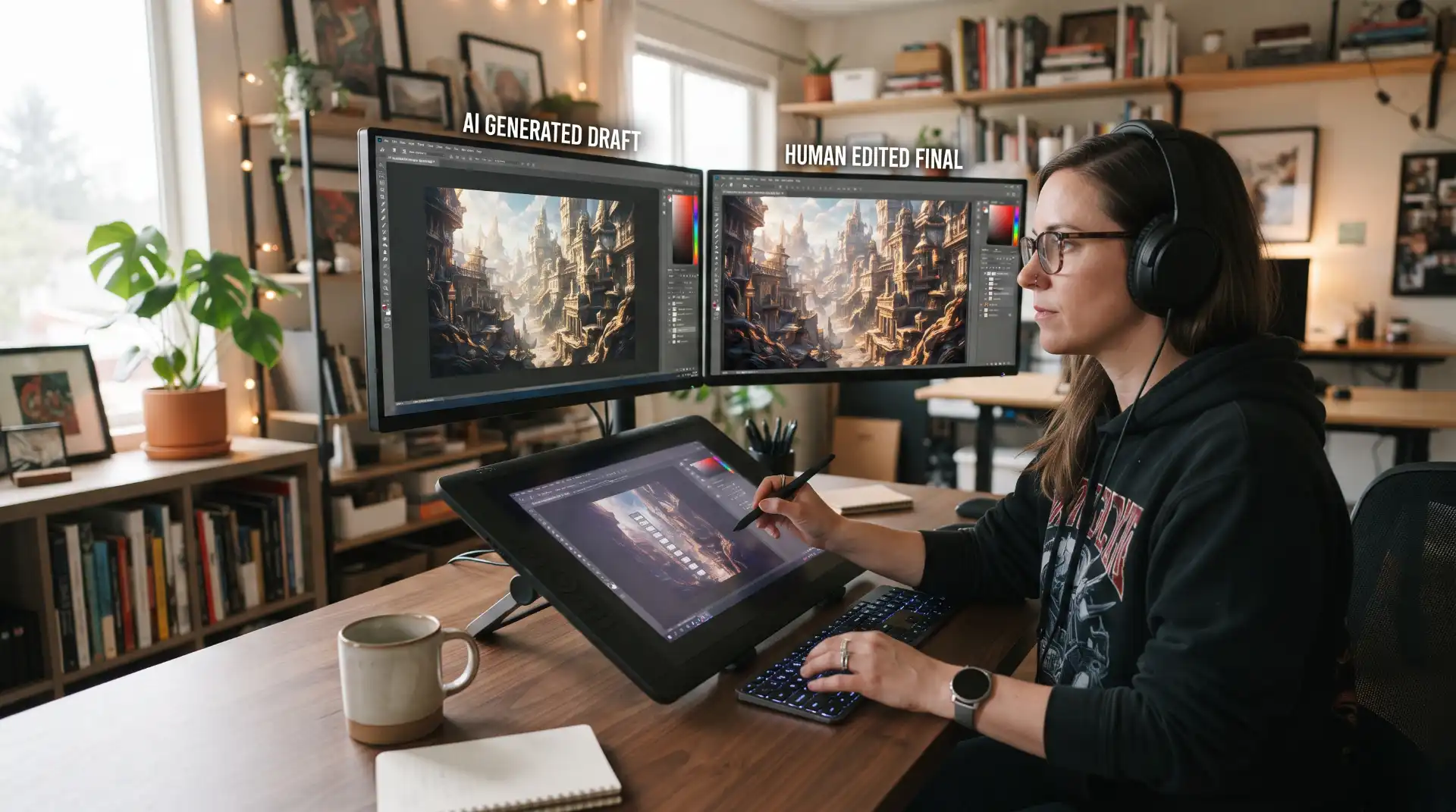
Editing AI Output Can Strengthen the Human Contribution
Creators who substantially transform generated material may have stronger claims to copyright in their additions or modifications than users who simply accept the first output.
Imagine that an AI system generates a digital landscape.
One user downloads the image immediately.
Another user imports the same kind of generated starting point into professional editing software, redraws the foreground, changes the architecture, creates new characters, modifies lighting, paints additional details, restructures the composition, and adds independently designed elements.
Those situations involve very different levels of human creativity.
The second creator can point to specific expressive decisions personally made in the final work.
This does not necessarily transform every underlying AI-generated pixel into protected expression. But the human-created additions may themselves qualify for copyright.
For businesses, that means creative workflows matter.
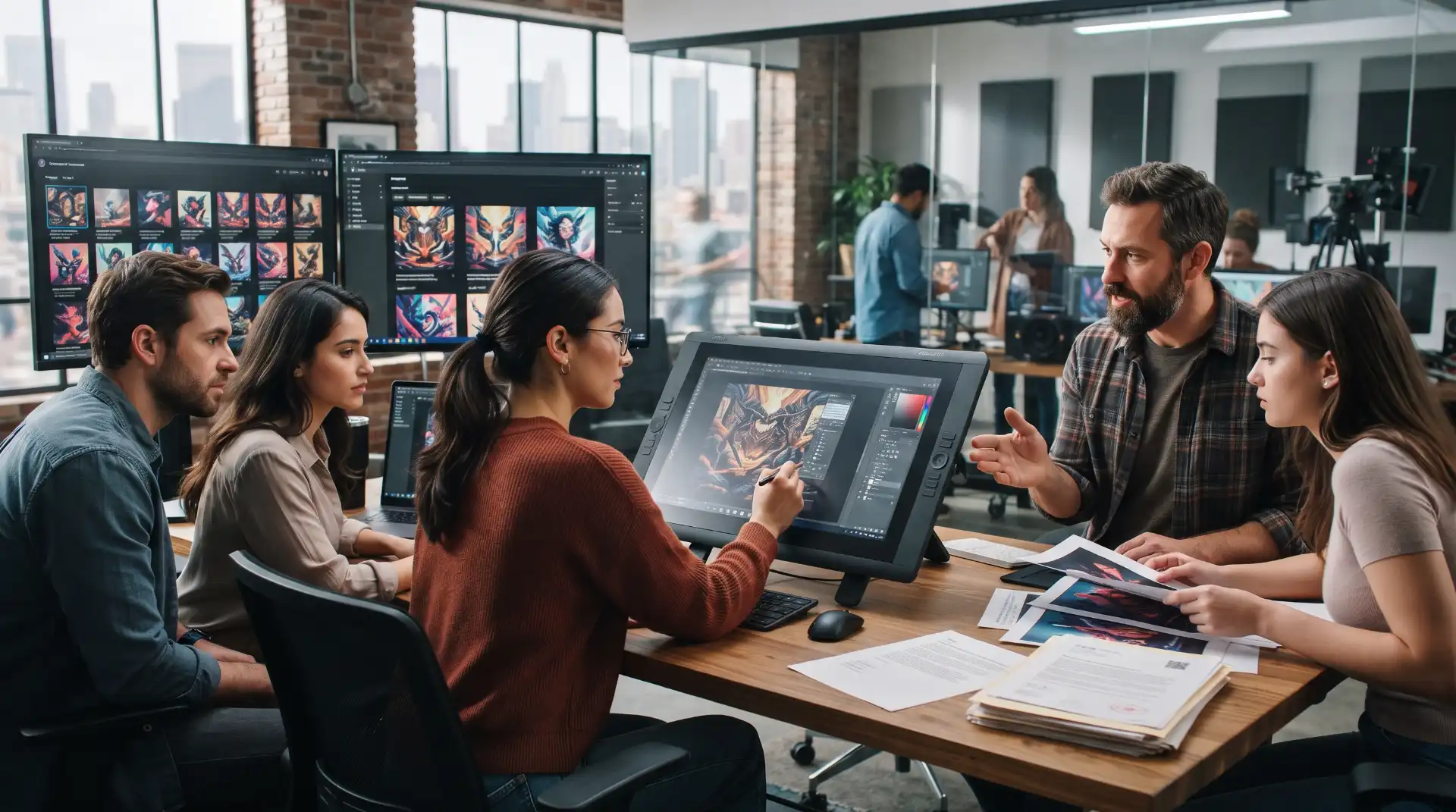
Companies that expect valuable intellectual property from AI-assisted production may benefit from designing processes that preserve meaningful human creative control rather than treating employees primarily as prompt operators.
Software Developers Face the Same Question
AI copyright is not only an issue for visual artists.
Software developers increasingly rely on coding assistants to write functions, suggest algorithms, debug code, create tests, generate documentation, and restructure applications.
That raises the same fundamental question: where is the human authorship?
A developer who designs an application’s architecture, chooses data structures, writes significant original code, evaluates generated suggestions, rewrites functions, and integrates components may possess copyright in substantial human-created portions of the finished program.
By contrast, a developer who simply requests an entire program and publishes the resulting machine-generated code without meaningful creative modification may face a more uncertain copyright position.
Legal Journal has examined this issue separately in Who Owns Software Created With Generative AI? and Open Source AI Code and Copyright Risks for U.S. Developers. These questions are increasingly interconnected because AI-assisted code can raise both copyrightability and potential third-party infringement or licensing concerns.
Copyrightability and Infringement Are Different Questions
This is another crucial distinction.
Asking whether an AI output can receive copyright protection is not the same as asking whether creating or using that output infringes someone else’s copyright.
These are separate legal issues.
An AI-generated image might lack enough human authorship to receive copyright protection while still potentially raising infringement concerns if it reproduces protectable elements from another person’s copyrighted work.
Likewise, a human may own copyright in an AI-assisted project while still facing allegations that some material incorporated into the project infringes third-party rights.
Generative AI training creates yet another category of legal questions.
The Copyright Office has been studying whether and under what circumstances the use of copyrighted works in generative AI training may implicate copyright law. Its broader AI initiative has separately addressed digital replicas, copyrightability, and generative AI training.
Creators should therefore avoid assuming that obtaining copyright protection automatically establishes that all inputs and outputs were lawfully used.
Ownership, copyrightability, infringement, licensing, and training practices can require separate analyses.
Why Businesses Should Document Human Creative Contributions
The post-Thaler environment makes documentation increasingly important.
A company may spend substantial money creating advertisements, software, photographs, product illustrations, videos, reports, marketing materials, game assets, or entertainment using generative AI.
Later, it may need to prove what part of those materials was actually created by employees or contractors.
If the company cannot reconstruct the creative process, ownership and enforcement may become harder.
Version histories can help show how a work developed.
Drafts can identify human-written passages.
Source files may show which layers were drawn or edited by a designer.
Software repositories can demonstrate which code was written, changed, selected, or integrated by developers.
Creative briefs and production records can document editorial decisions.
The purpose is not merely administrative.
When a business eventually seeks copyright registration, negotiates a license, conducts intellectual-property due diligence, sells a company, or pursues an infringement claim, identifying the human-authored material can become commercially significant.
AI Does Not Become an Author Because It Is Sophisticated
One argument likely to continue appearing as AI systems improve is that increasingly autonomous machines should eventually qualify as legal authors.
Current U.S. law does not take that approach.
The D.C. Circuit’s decision in Thaler focused on the Copyright Act’s human-authorship requirement rather than attempting to measure how intelligent or creative the machine appeared to be.
That distinction creates a relatively stable rule.
The legal question is not whether an artificial intelligence system appears inventive, surprising, artistic, or sophisticated.
It is whether copyright law recognizes that system as an author.
At present, it does not.
This also prevents a potentially difficult legal problem involving machine ownership.
An AI system cannot ordinarily enter licensing agreements, receive royalties, sue infringers, transfer rights, inherit property, or exercise the other legal capacities expected of a copyright owner.
Treating AI as an author would therefore require broader policy decisions than simply determining whether an output looks creative.
Could Congress Change the Human-Authorship Rule?
Congress has the authority to amend federal copyright law, and future technological developments could generate proposals for new forms of protection.
For now, however, the Copyright Office has not concluded that purely AI-generated works require a new copyright regime.
Its 2025 report found that existing copyright principles remain capable of protecting human-created expression while leaving material generated without sufficient human authorship outside traditional copyright protection.
That approach reflects an important policy question.
Copyright does not exist simply to place ownership labels on every valuable product.
The system is intended to encourage human creativity and the production and dissemination of expressive works.
If machines can produce vast quantities of material at extremely low cost, lawmakers would need to consider whether granting exclusive rights in purely generated output would encourage useful creativity or instead allow enormous volumes of machine-generated content to become privately controlled.
Those questions may become more important as generative systems continue improving.
But in 2026, the basic U.S. framework remains centered on people.
What Creators Should Take From Thaler in 2026
The most important lesson from Thaler is not that creators should stop using AI.
It is that creators should understand where authorship originates.
AI can help brainstorm, edit, visualize, compose, generate alternatives, accelerate repetitive work, assist programmers, transform rough drafts, and expand creative experimentation.
None of those uses automatically eliminate copyright.
The problem arises when a user assumes that requesting an output is legally equivalent to personally creating the expressive elements within it.
Under the current U.S. framework, that assumption can be risky.
Creators who want stronger copyright claims should retain meaningful control over protectable expression. Writers can personally write and revise text. Artists can draw, paint, edit, composite, and modify generated material. Developers can design architecture and substantially author or revise code. Filmmakers can use generated elements within a broader human-directed production.
The more clearly a creator can identify original human expression in the finished work, the easier it becomes to explain what the copyright actually protects.
The Future of AI Copyright Is Really About the Meaning of Authorship
The generative AI debate often sounds like a battle between technology and copyright law.
The real issue is more fundamental.
Copyright has always depended on identifying an author.
Artificial intelligence forces courts, regulators, businesses, and creators to ask what authorship means when software can produce convincing expressive material with little direct human involvement.
For now, U.S. law has drawn a clear boundary.
AI can be a tool.
AI-generated material can form part of a larger work.
Human creators can obtain copyright protection for qualifying original contributions to AI-assisted projects.
But an artificial intelligence system itself is not recognized as the copyright author of a work simply because it generated the expressive output.
The D.C. Circuit reinforced that principle in Thaler v. Perlmutter. The Supreme Court’s March 2, 2026 refusal to review the case left that judgment undisturbed, while the U.S. Copyright Office continues to evaluate AI-assisted works through the lens of human creative contribution.
For creators working in 2026, the practical question therefore remains surprisingly traditional despite the extraordinary technology involved:
What did the human create?
As long as copyright law continues to focus on that question, human authorship will remain the dividing line between using artificial intelligence as a creative tool and asking a machine to become the author itself.
For additional authoritative guidance, readers can review the U.S. Copyright Office’s ongoing Copyright and Artificial Intelligence initiative, including its reports addressing copyrightability, digital replicas, and generative AI training. U.S. Copyright Office — Copyright and Artificial Intelligence
This article provides general information about U.S. copyright law and does not constitute legal advice. Copyright outcomes may depend on the particular work, the nature of the human contribution, registration representations, contractual arrangements, and subsequent legal developments.