

Cybersecurity and Intellectual Property: Protecting Trade Secrets From Data Breaches
In the modern U.S. economy, intellectual property is often stored, developed, and exchanged entirely through digital systems. A company’s most valuable trade secrets may exist as source code, engineering drawings, manufacturing processes, customer information, pricing strategies, algorithms, product specifications, research files, or internal business plans. While these assets may never be publicly registered like patents or trademarks, they can represent enormous commercial value.
That value also makes trade secrets attractive targets for cybercriminals, competitors, malicious insiders, ransomware groups, and other unauthorized actors. A successful data breach can expose confidential information within minutes. Once sensitive information has been copied or disclosed, recovering the files does not necessarily restore the secrecy that made them valuable in the first place.
For U.S. businesses, cybersecurity and intellectual property protection are therefore increasingly connected. Protecting trade secrets is not simply a matter of signing nondisclosure agreements or marking documents “confidential.” Companies must also take reasonable measures to protect confidential information from unauthorized access, use, acquisition, and disclosure.
Cybersecurity controls can play an important role in demonstrating those protective efforts. Access restrictions, multifactor authentication, encryption, network segmentation, monitoring, employee training, vendor controls, incident response procedures, and other safeguards can help reduce the likelihood that valuable intellectual property will be exposed.
This article examines the relationship between cybersecurity and trade secret protection in the United States, explains how data breaches can threaten intellectual property, and discusses practical steps businesses can take to protect confidential information.
What Is a Trade Secret Under U.S. Law?
Trade secrets are a distinct category of intellectual property. Unlike patents, which generally require public disclosure of an invention in exchange for a limited period of exclusive rights, trade secret protection depends on maintaining the secrecy of valuable information.
Under the federal Defend Trade Secrets Act, commonly known as the DTSA, information can qualify as a trade secret when it derives independent economic value from not being generally known or readily ascertainable and when the owner takes reasonable measures to keep the information secret.
This means secrecy is central to the legal protection. A company cannot simply claim that every internal document is a trade secret. The business generally needs to demonstrate both that the information has the necessary economic value and that reasonable efforts were made to maintain its confidentiality.
Examples can include proprietary manufacturing processes, formulas, technical specifications, software source code, algorithms, research and development information, customer strategies, pricing information, supplier information, business plans, and certain forms of proprietary data.
The exact legal analysis depends on the circumstances and applicable law. Federal protection under the DTSA exists alongside state trade secret laws, many of which are based on versions of the Uniform Trade Secrets Act.
For businesses, one practical lesson is particularly important: cybersecurity is increasingly part of the broader evidence showing how seriously a company treated the confidentiality of its information.

Why Data Breaches Can Threaten Trade Secret Protection
A conventional data breach is often discussed in terms of personal information, financial records, healthcare information, or account credentials. However, businesses can lose another category of highly valuable information during the same incident: intellectual property.
Consider a technology company whose development environment contains proprietary source code and unreleased product specifications. An attacker who obtains administrator credentials may gain access to both customer information and the company’s development environment.
Similarly, a manufacturing company could experience a ransomware attack that encrypts internal engineering documents while attackers simultaneously copy confidential designs. Even if the company restores its systems from backups, the attackers may still possess the stolen information.
This creates a difficult distinction between restoring data and restoring secrecy. A backup may help a company recover its files, but it cannot necessarily undo an unauthorized disclosure.
NIST’s National Cybersecurity Center of Excellence describes data confidentiality as protecting information from unauthorized access and disclosure and emphasizes the operational and financial consequences that can follow a confidentiality failure.
For companies that rely heavily on confidential information, the consequences may therefore extend beyond the ordinary costs associated with a cybersecurity incident.
Cybersecurity Is Part of a Trade Secret Protection Strategy
Trade secret protection and cybersecurity should not be treated as completely separate legal and technical programs. They overlap in an important way: both are concerned with preventing unauthorized access to valuable information.
A company may have a strong confidentiality agreement with an employee, but that agreement cannot physically prevent a compromised account from accessing a database. Likewise, a sophisticated cybersecurity system cannot replace appropriate contracts and policies that explain what employees are allowed to do with confidential information.
The strongest approach combines legal, organizational, and technical safeguards.
Businesses should first identify what information actually has commercial value. They can then determine where that information is stored, who can access it, how it moves through the organization, which vendors can access it, and what happens when an employee leaves.
This process creates a clearer connection between intellectual property management and cybersecurity risk management.
Identifying the Company’s Most Valuable Trade Secrets
One of the first steps in protecting trade secrets is identifying them.
A business may have thousands or millions of digital files, but not every document has the same level of commercial importance. Treating every file identically can make security programs difficult to manage and may make it harder to demonstrate which information the company actually considered especially sensitive.
Businesses can create an internal inventory of confidential information and categorize assets according to their importance. A technology company, for example, may identify source code, unreleased product designs, proprietary algorithms, technical research, and internal architecture documents as particularly sensitive.
A manufacturer may prioritize formulas, production processes, engineering drawings, tooling specifications, supplier information, and manufacturing techniques.
A professional services company could have valuable client lists, pricing methodologies, internal procedures, research, and business strategies.
The inventory does not necessarily need to be complicated. The important objective is to understand what information needs protection and why.
Access Controls Can Help Protect Trade Secrets
One of the most important cybersecurity principles for confidential information is limiting access to people who actually need it.
An employee who does not need access to a company’s proprietary engineering database should generally not have unrestricted access to it. Similarly, a marketing employee may not need access to confidential source code, while a software developer may not need access to sensitive financial records.
This principle is commonly described as least-privilege access.
Applying least privilege can reduce the consequences of a compromised account. If an attacker obtains one employee’s credentials, the damage may be more limited when that account cannot access every confidential system within the organization.
Companies should also periodically review access permissions. Employees change jobs, departments, and responsibilities. A person who needed access to a particular project six months ago may no longer need it today.
Excessive permissions can create unnecessary intellectual property risk.
Multifactor Authentication and Trade Secret Security
Passwords remain a common target for attackers. Phishing campaigns, credential theft, password reuse, and other techniques can allow unauthorized individuals to obtain legitimate login credentials.
Multifactor authentication can provide an additional layer of protection by requiring more than a password before access is granted.
For systems containing highly valuable intellectual property, businesses should consider whether stronger authentication controls are appropriate. Administrative accounts, remote access systems, cloud environments, source-code repositories, and other high-value systems can require particular attention.
Multifactor authentication does not eliminate cyber risk. However, it can make stolen passwords less useful to attackers and can become one component of a broader security strategy.
Encryption and Confidential Intellectual Property
Encryption can help protect trade secrets both while information is stored and while it is transmitted.
For example, a company may encrypt confidential files stored on laptops, servers, cloud platforms, or removable devices. Encryption can also help protect information moving between systems.
The precise technical implementation should reflect the company’s environment and risk profile. Businesses handling particularly sensitive intellectual property should work with qualified cybersecurity professionals to determine appropriate encryption practices.
Encryption is especially important for mobile workforces. Employees may access confidential information from home offices, hotels, airports, coworking spaces, and other locations outside traditional corporate facilities.
A stolen laptop or compromised device can become an intellectual property incident if confidential files are easily accessible.
Cloud Computing Creates New Trade Secret Risks
Cloud services have changed how American businesses store and collaborate on intellectual property. Teams can work together on documents, software, designs, and research without maintaining all systems inside a corporate office.
Cloud computing can provide significant operational advantages, but businesses must understand how confidential information is stored and shared.
Access permissions, external sharing settings, administrator privileges, authentication, logging, vendor security, and data retention policies can all affect the confidentiality of trade secrets.
An employee who accidentally creates a public sharing link to a confidential document may expose information without intending to do so.
Businesses should therefore establish clear policies governing external sharing and should periodically review cloud configurations for sensitive systems.
Remote Work and Intellectual Property Protection
Remote and hybrid work have created additional challenges for companies attempting to protect trade secrets.
An employee may access confidential information from a personal computer, home network, mobile device, or third-party application. Each additional environment can introduce another potential access point.
Companies can reduce unnecessary risk by establishing policies for remote access, requiring appropriate authentication, controlling company devices, restricting unauthorized applications, and educating employees about phishing and other common threats.
Remote work policies should also explain how employees are expected to handle confidential documents. Printing sensitive information at home, storing files on personal cloud accounts, sending documents to personal email addresses, or using unauthorized applications can create significant confidentiality concerns.

Employees Are an Important Part of Trade Secret Security
Technology alone cannot protect every trade secret. Employees remain an important part of an organization’s security program.
Employees should understand what information is confidential, how it should be handled, where it may be stored, and who is authorized to receive it.
Training can also address phishing, social engineering, suspicious attachments, unauthorized software, personal cloud storage, removable devices, and other common sources of information exposure.
Companies should consider providing additional training to employees who regularly handle highly sensitive intellectual property.
Confidentiality obligations should also be communicated clearly. Employment agreements, confidentiality agreements, intellectual property policies, and employee handbooks can establish expectations, although the specific legal language should be reviewed for compliance with applicable federal and state law.
Employee Departures Can Create Cybersecurity Risks
Employee departures represent another important moment for trade secret protection.
An employee leaving the company may have legitimate knowledge and skills that they can take to another employer, but company-owned confidential information must be handled differently.
Businesses should have procedures for removing access when employment ends. Accounts, remote-access credentials, cloud permissions, software repositories, physical access cards, company devices, and other access mechanisms should be addressed as appropriate.
Companies may also want to review whether the departing employee downloaded, copied, transferred, or otherwise accessed sensitive information shortly before departure.
These measures should be implemented consistently and in accordance with applicable employment and privacy laws.
Legal Journal has previously examined the relationship between trade secrets and employee mobility in its article Trade Secrets & Employee Mobility: New Risks After Court Decisions.
Third-Party Vendors Can Become a Trade Secret Weak Point
A company’s trade secrets may not remain entirely inside its own systems.
Software providers, contractors, consultants, manufacturers, cloud vendors, law firms, accounting firms, marketing agencies, and other service providers may receive access to confidential information.
Every third party with access can introduce additional risk.
Vendor agreements should therefore address confidentiality, data security, access restrictions, incident notification, intellectual property ownership, and other relevant issues. The appropriate contractual provisions depend on the nature of the relationship and the information being shared.
Businesses should also consider whether vendors have appropriate cybersecurity practices for the information they receive.
A company cannot necessarily eliminate every third-party risk, but understanding where sensitive information travels can make those risks easier to manage.
Artificial Intelligence Adds Another Layer of Risk
Generative artificial intelligence has created new questions for businesses protecting confidential information.
Employees may use AI tools to summarize documents, write code, analyze data, conduct research, or solve technical problems. If an employee enters confidential company information into an external AI service without authorization, sensitive information may leave the organization’s controlled environment.
The precise technical and contractual treatment of information varies among AI providers and products. Businesses should therefore avoid assuming that an AI tool is appropriate for confidential information simply because it is widely used.
Organizations can establish internal AI-use policies explaining what information employees may provide to external systems and what information must remain within approved environments.
This is particularly important for companies whose competitive advantage depends on proprietary algorithms, source code, product designs, research, customer information, or other confidential data.
Legal Journal has also examined this issue in Generative AI and Trade Secret Protection for Businesses, which discusses how uncontrolled AI use can create risks for confidential business information.
Source Code Can Be Both Intellectual Property and a Security Target
Software companies often rely on multiple forms of intellectual property protection at the same time.
Copyright may apply to qualifying software code. Patents may protect certain eligible inventions. Trademarks can protect brand identifiers. Trade secret law can protect confidential technical information when its legal requirements are satisfied.
Source code can be particularly sensitive because unauthorized access can reveal how a product works internally.
An attacker who steals source code may attempt to sell it, use it to create competing products, identify vulnerabilities, or combine it with other stolen information.
Businesses should therefore carefully consider who can access repositories containing proprietary code and how those repositories are monitored.
AI-assisted software development introduces additional questions concerning confidentiality, licensing, provenance, and ownership. Legal Journal’s recent article Software Patents and Generative AI: What Developers and Companies Need to Know explores related intellectual property issues for U.S. developers and companies.
Incident Response Should Include Intellectual Property
When a cyberattack occurs, companies often focus immediately on stopping the attack and restoring operations. Those steps are essential, but intellectual property should also be considered during the incident response process.
Organizations should determine what systems were accessed and what information may have been viewed, copied, modified, or exfiltrated.
That means incident response teams may need to work closely with information technology personnel, cybersecurity specialists, executives, legal counsel, and other appropriate professionals.
The response should be documented carefully. Logs, access records, forensic findings, communications, and other relevant evidence may become important later.
Businesses should also consider evidence preservation. If litigation becomes necessary, information about what happened during the incident may be highly relevant.
What Happens When Trade Secrets Are Stolen?
A suspected theft of trade secrets can create multiple legal questions.
Companies may need to determine how the information was obtained, who obtained it, whether the information qualifies as a trade secret, whether reasonable secrecy measures were in place, whether the information was used or disclosed, and what harm resulted.
Under the federal Defend Trade Secrets Act, certain forms of misappropriation can give qualifying trade secret owners access to federal civil remedies. State laws may also provide remedies.
Potential legal remedies can depend on the facts of the case and may include injunctive relief, damages, and other remedies authorized by applicable law.
Businesses should consult qualified legal counsel when a suspected trade secret theft occurs because the appropriate response can depend heavily on the circumstances.
Data Breach Notification Is Not the Same as Trade Secret Protection
It is important to distinguish trade secret protection from data breach notification obligations.
Many U.S. data breach notification laws focus primarily on certain categories of personal information. Depending on the jurisdiction and circumstances, a breach involving customer or employee information may trigger notification requirements.
A stolen trade secret does not automatically create the same notification obligation simply because the information is confidential business information.
However, a single cyberattack can involve both categories. For example, an attacker could steal customer Social Security numbers while also taking proprietary product designs.
The business may therefore face privacy, cybersecurity, contractual, regulatory, intellectual property, and litigation considerations arising from the same incident.
Because U.S. data security and privacy requirements can vary by state and industry, companies should evaluate applicable obligations with appropriate legal counsel.
How NIST Guidance Can Help U.S. Businesses
The National Institute of Standards and Technology provides cybersecurity resources that businesses can use when developing security programs.
In 2026, NIST released revisions to SP 800-172 and related assessment procedures addressing enhanced security requirements for protecting controlled unclassified information in nonfederal systems. The updated material includes areas such as access controls, network segmentation, asset management, supply chain security, and cyber resiliency.
Not every business is subject to the same federal requirements or needs to implement every control described in government cybersecurity publications. Nevertheless, NIST resources can provide useful frameworks for organizations evaluating their cybersecurity practices.
Businesses can also review NIST’s resources on data confidentiality, detection, response, and recovery when developing or improving their incident response programs.
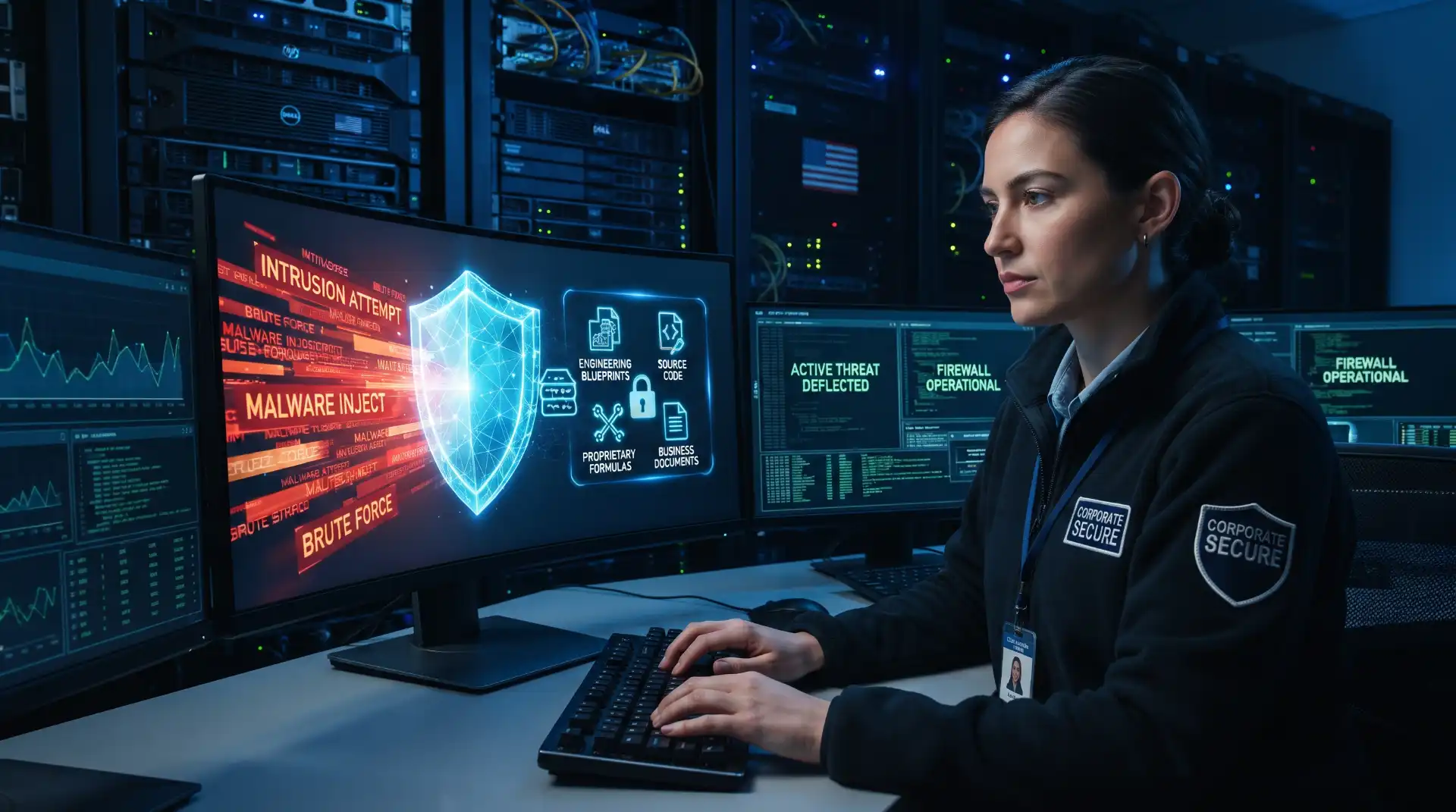
Creating a Trade Secret Cybersecurity Program
A practical program should begin with information identification.
The company should understand what information is commercially sensitive, where that information is stored, and who has access to it. This can provide the foundation for applying appropriate technical and organizational safeguards.
The next step is access management. Businesses should limit sensitive information to individuals and systems that require it for legitimate business purposes.
Authentication should be strengthened, especially for administrative accounts and systems containing high-value intellectual property. Monitoring and logging can help organizations identify unusual access patterns.
Employee and contractor policies should address confidentiality, remote work, cloud applications, removable media, personal accounts, and artificial intelligence tools.
Vendor relationships should receive similar attention. Contracts and security assessments can help organizations understand how third parties handle confidential information.
Finally, the organization should maintain an incident response process that specifically considers intellectual property loss.
Regular Security Reviews Matter
Cybersecurity is not a one-time project.
Technology changes, employees change roles, vendors change, applications are added, and attackers develop new techniques.
A security control that was appropriate two years ago may no longer provide adequate protection for a company’s most valuable information.
Regular security assessments can help businesses identify outdated permissions, forgotten accounts, vulnerable systems, excessive data access, and other weaknesses.
Trade secret inventories should also be reviewed periodically. New products, acquisitions, research projects, software platforms, and business strategies can create new categories of confidential information.
The goal is to keep legal protection and cybersecurity practices aligned with the company’s actual operations.
Why Documentation Matters
Documentation can play an important role in demonstrating that a business takes confidentiality seriously.
Written policies can establish how confidential information should be handled. Access-control records can demonstrate who has permission to use particular systems. Employee training records can show that personnel received security guidance. Vendor agreements can document confidentiality obligations.
Security assessments and incident response records can also demonstrate that the company actively evaluates and addresses cybersecurity risks.
Documentation does not automatically establish that information qualifies as a trade secret. However, organized records can help a company explain the measures it took to protect confidential information.
Balancing Security With Business Operations
Trade secret protection does not mean making every system inaccessible.
Employees need to collaborate. Engineers need to share technical information. Sales teams may need customer data. Executives need business reports. Contractors may require limited project access.
The challenge is creating a system that allows legitimate business activity while reducing unnecessary exposure.
Overly restrictive controls can cause employees to search for unofficial workarounds. Poorly designed security policies may therefore create new risks instead of eliminating existing ones.
Effective programs should be practical, understandable, and aligned with the company’s actual workflow.
Cybersecurity and Intellectual Property Are Now Closely Connected
For many U.S. businesses, the boundary between cybersecurity and intellectual property protection has become increasingly difficult to separate.
A patent application may begin as confidential research. A software company’s competitive advantage may depend on proprietary source code. A manufacturer may rely on an undisclosed production technique. A startup may have a valuable algorithm that it has not publicly disclosed.
In each example, unauthorized disclosure can reduce the commercial value of the information.
That is why trade secret protection requires more than a legal document. Confidentiality agreements, employment contracts, intellectual property policies, cybersecurity controls, employee training, vendor management, access restrictions, monitoring, and incident response can all contribute to a broader protection strategy.
Companies should also recognize that cybersecurity failures can have legal consequences extending beyond the immediate technical incident. A breach may lead to business interruption, contractual disputes, regulatory inquiries, litigation, reputational damage, and potential intellectual property claims.
Conclusion
Trade secrets are among the most important intellectual property assets held by many U.S. businesses. Unlike registered intellectual property rights, trade secret protection depends heavily on maintaining confidentiality and taking reasonable measures to protect valuable information.
Cybersecurity therefore has an important role in modern trade secret protection.
Businesses can reduce risk by identifying their most valuable confidential information, limiting access, strengthening authentication, using appropriate encryption, monitoring sensitive systems, controlling third-party access, training employees, reviewing AI usage, managing employee departures, and preparing for incidents before they occur.
Companies should also understand that recovering files after a breach is not necessarily the same as restoring secrecy. Once confidential information has been copied or publicly disclosed, the commercial consequences can be difficult to reverse.
A comprehensive intellectual property strategy should therefore consider cybersecurity from the beginning. Legal protections and technical safeguards work most effectively when they support the same objective: keeping valuable information confidential and preserving the competitive advantage that information provides.
For businesses operating in the United States, the appropriate approach will depend on the type of information involved, the industry, applicable federal and state laws, contractual obligations, and the company’s particular cybersecurity environment. Businesses facing an actual breach or suspected trade secret misappropriation should obtain advice from qualified legal and cybersecurity professionals.
This article is provided for educational and informational purposes only and does not constitute legal advice. Laws and regulatory requirements can change, and businesses should consult qualified counsel regarding their specific circumstances.