Open Source AI Code and Copyright Risks for Developers
Artificial intelligence coding assistants have quickly become part of everyday software development. Developers now use them to generate functions, troubleshoot bugs, explain unfamiliar code, produce tests, create documentation, and accelerate routine programming tasks.
However, faster development creates a new legal problem.
AI-generated code may interact with copyright law and open-source software licenses in ways that developers do not immediately recognize. A coding assistant can produce something that looks completely original while still resembling code available in a public repository.
That does not automatically mean copyright infringement occurred. It also does not mean the code is automatically safe to use.
For U.S. developers, the issue requires examining several separate questions. Who created the code? Is the output copyrightable? Does it reproduce protected material? Does an open-source license apply? What obligations might arise if the code enters a commercial product?
Understanding those distinctions is becoming a basic part of modern software governance.
AI Coding Assistants Have Changed Software Development
Generative AI has moved beyond simple autocomplete tools.
A developer can now describe a function in ordinary language and receive an implementation within seconds. AI coding assistants can create database queries, API integrations, authentication logic, front-end components, testing frameworks, and substantial portions of an application.
That convenience changes the development process.
Traditionally, a programmer either wrote the code personally or incorporated third-party software from an identifiable source. The developer could usually determine where a library originated and review its license.
AI adds another layer.
A developer may receive source code without immediately knowing whether similar code exists elsewhere. The output may be routine programming logic, independently generated expression, material resembling public code, or a combination of several influences.
This uncertainty creates copyright and licensing questions before the code reaches production.
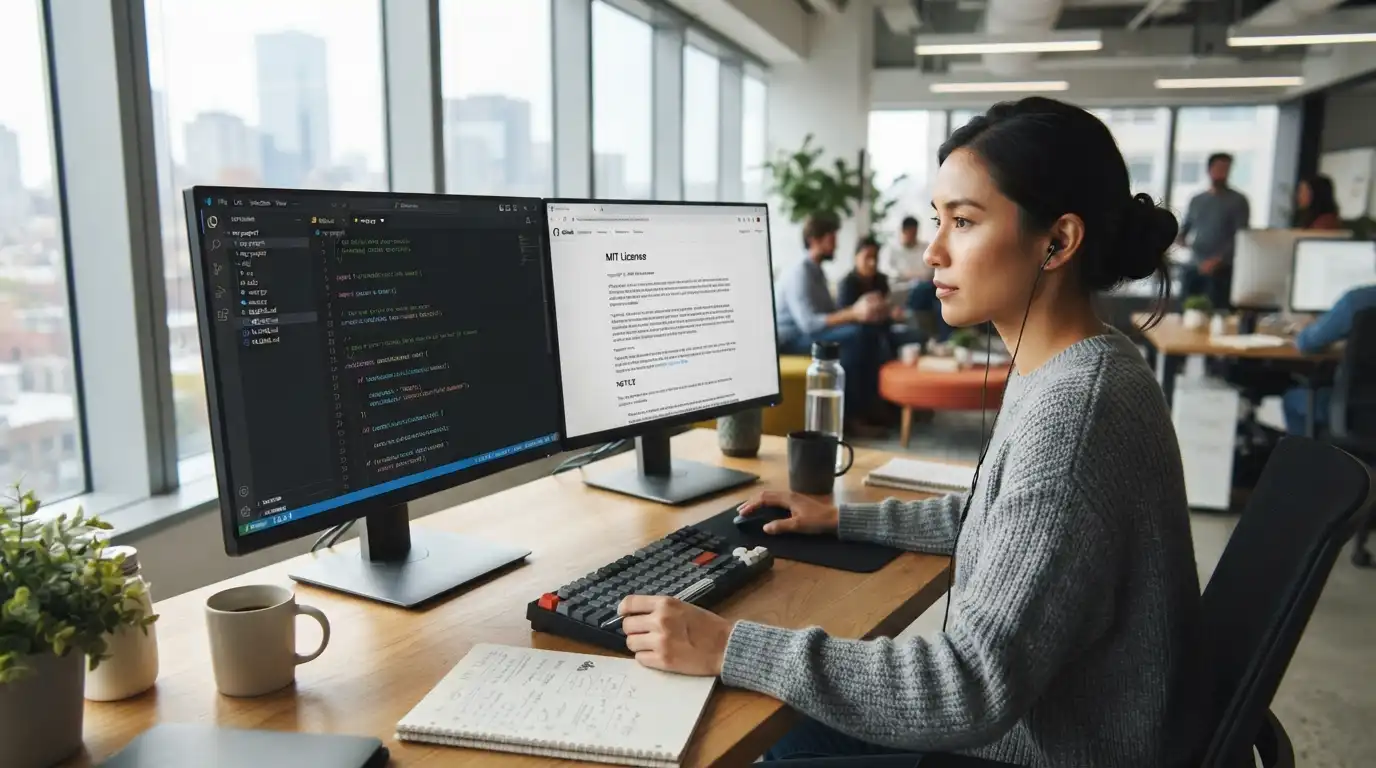
Open Source Does Not Mean No Copyright
One of the most common misunderstandings about open-source software is that it has no copyright restrictions.
Open-source software generally remains copyrighted.
The copyright owner instead grants users permission to use the software under specific licensing terms. Those permissions may allow copying, modification, redistribution, or commercial use.
The exact conditions depend on the license.
The Open Source Initiative describes open-source licenses as licenses allowing software to be freely used, modified, and shared. However, different licenses impose different requirements.
Some licenses are relatively permissive.
Others contain stronger requirements that may apply when modified or derivative software is distributed.
For example, certain licenses may require preservation of copyright notices. Others may require distribution of source code under specified conditions.
Developers therefore cannot treat the phrase “open source” as equivalent to “do anything you want.”
The license remains part of the legal analysis.
AI-Generated Code Can Create an Attribution Problem
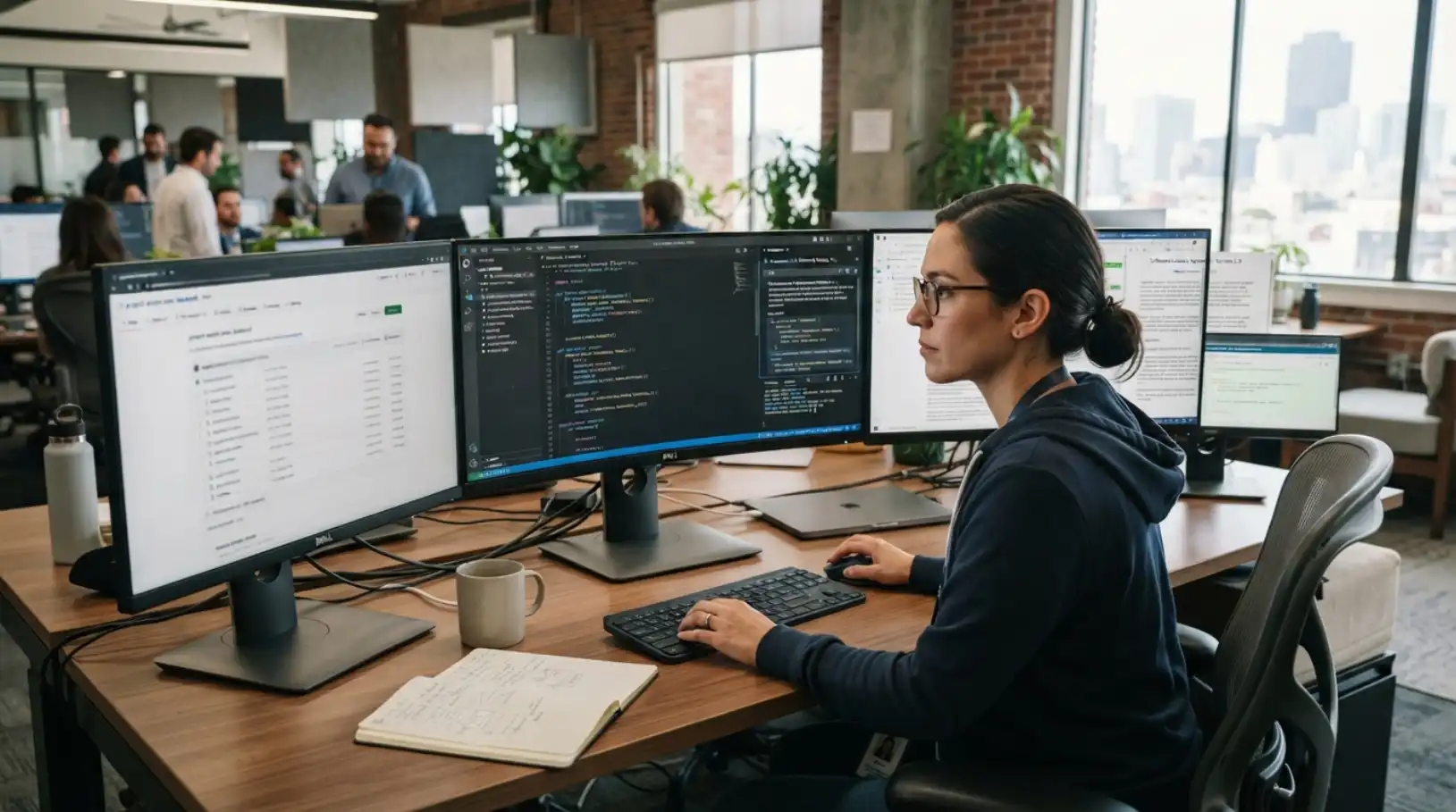
Imagine that a developer asks an AI coding assistant to create a utility for parsing files.
The tool produces 50 lines of code.
Nothing in the response identifies a particular repository. The developer places the code into a commercial application and continues working.
Later, someone discovers that a substantially similar implementation appears in a public repository.
Several questions immediately arise.
Was the similarity caused by the limited number of practical ways to write the function?
Did the AI independently produce commonplace programming instructions?
Does the output reproduce copyrightable expression?
Is the source repository covered by an open-source license?
Does that license require attribution, notices, source disclosure, or other actions?
These questions cannot always be answered by looking at the generated code alone.
Context matters.
Software developers should therefore avoid assuming that machine-generated code has no source-related concerns.
Copyright Protects Expression Rather Than Programming Ideas
U.S. copyright law can protect original expression contained in computer programs.
Copyright does not generally give someone ownership over an abstract programming idea, method, system, algorithm, or underlying function merely because that person wrote one implementation.
That distinction matters for AI-generated software.
Two programmers may independently create similar code when implementing a basic technical function. Common programming conventions may also result in similar structures.
Short or highly functional code may contain limited copyrightable expression.
More elaborate source code can present a different situation.
If AI output reproduces sufficiently original protected expression from another program, copyright concerns may become more significant.
The analysis is fact-specific.
Developers should not assume that any similarity automatically creates infringement. They also should not assume that generated code becomes legally unrestricted simply because an AI system produced it.
Human Authorship Creates Another Copyright Question
AI-generated code creates a separate issue involving ownership of the output itself.
The U.S. Copyright Office continues to center copyright protection on human authorship.
Its artificial intelligence guidance recognizes that people can use AI as an assistive technology while retaining copyright protection for qualifying human-created expression.
Purely machine-generated expression presents a different problem.
Providing a prompt alone may not establish copyright in expression that the AI system determines.
Software development rarely fits neatly into either category.
A programmer may generate an initial function using AI and then substantially revise it. Another developer may design the architecture but use AI for several routine components.
A team may use AI only to identify bugs while humans write the actual source code.
These situations contain different levels of human contribution.
That means copyright ownership may depend partly on what developers actually contributed to the finished software.
Legal Journal has also examined this broader question in its article “Who Owns Software Created With Generative AI?”
That article can serve as a useful internal link because ownership and open-source compliance frequently overlap.
Copyrightability and Infringement Are Different Questions
Developers should keep two concepts separate.
The first asks whether AI-generated code itself qualifies for copyright protection.
The second asks whether the output infringes someone else’s copyrighted code.
Those questions can produce different answers.
Suppose an AI system produces a block of code that lacks sufficient human authorship to qualify independently for U.S. copyright protection.
That does not automatically mean the code cannot create infringement concerns.
If the output reproduces protected expression from another copyrighted program, the owner of that earlier work may still have rights worth considering.
In other words, lack of copyright protection for an AI output does not necessarily create a legal safe zone.
Companies evaluating AI-generated software should examine both sides of the issue.
Public Code Matching Deserves Attention
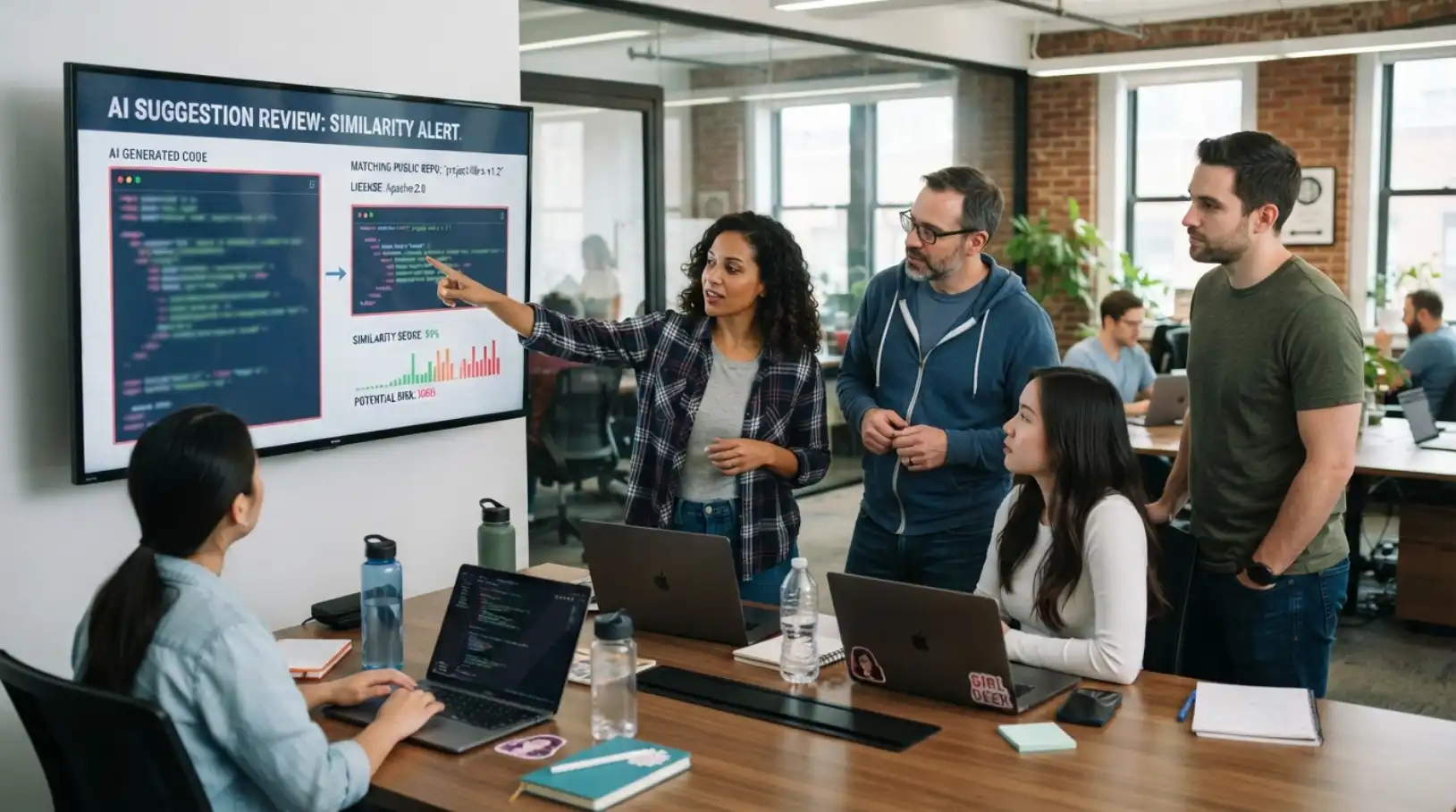
Some AI coding platforms provide tools designed to identify generated suggestions that resemble publicly available code.
GitHub, for example, currently provides settings related to suggestions matching public code.
Its documentation explains that users may receive information about matching code and associated repositories when appropriate settings are enabled.
GitHub also advises users to apply precautions similar to those used with other third-party material.
Those precautions include testing, intellectual property scanning, and security review.
That advice highlights an important point.
AI coding assistants can improve productivity, but developers remain responsible for reviewing what enters their projects.
Organizations should treat AI-generated suggestions much like other outside code contributions.
A developer would normally inspect code copied from an unfamiliar repository before adding it to a commercial application.
AI output deserves similar scrutiny.
Permissive and Copyleft Licenses Create Different Risks
Open-source licenses do not all operate the same way.
Some widely used licenses are considered permissive because they generally allow broad reuse subject to relatively limited conditions.
MIT, BSD, and Apache licenses are common examples.
Other licenses use stronger copyleft requirements.
The GNU General Public License is a prominent example.
Depending on the circumstances, distribution of software incorporating GPL-covered material can create obligations involving source availability and licensing terms.
The exact analysis depends on the software architecture, the license version, the nature of the use, and the manner of distribution.
That distinction matters when AI-generated code closely matches licensed software.
Suppose generated code resembles material from a permissively licensed repository.
The developer may need to consider attribution or notice requirements.
If generated code instead reproduces material governed by a stronger copyleft license, additional questions may arise.
A company may therefore need to identify the source and license before deciding whether generated code belongs in a proprietary product.
AI Does Not Erase License Conditions
Developers sometimes view AI-generated output as a new layer that separates them from the original material.
Legally, that assumption may be unreliable.
If copyrightable code remains substantially reproduced, passing the material through an AI system does not necessarily erase the underlying owner’s rights.
The same practical concern applies to licensing.
A company should not assume that software becomes free of licensing obligations merely because an AI system produced a similar version.
The central questions remain focused on what the output contains and what legal rights apply.
This issue may become particularly relevant as coding models become more capable of producing larger blocks of source code.
Training Data and Output Risks Should Also Be Separated
Discussions about AI copyright often combine two different subjects.
One involves using copyrighted material to train an AI model.
The other involves the content produced by that model.
These are related but legally distinct questions.
The U.S. Copyright Office has examined generative AI training and licensing as part of its broader artificial intelligence initiative.
Its analysis recognizes ongoing debate over when copyrighted works used for AI training may require licenses.
For an ordinary software developer using a coding assistant, however, the more immediate concern may involve the output placed into a product.
The developer usually does not control the model’s training process.
The developer does control whether generated code enters a company repository.
That makes output review one of the most practical areas for managing risk.
Software Companies Need AI Code Policies
Organizations increasingly need internal policies covering the use of generative AI in development.
A useful policy does not need to prohibit AI.
Instead, it can define acceptable uses and review procedures.
Companies can identify approved coding assistants, determine which projects may use them, and restrict sensitive data from being entered into external platforms.
Policies can also require review when substantial generated code appears in production.
The goal is traceability.
A company should ideally know how important portions of its software were created.
That becomes especially relevant during mergers, financing rounds, licensing deals, security audits, or intellectual property disputes.
A buyer investigating a software company may want to know whether critical code came from employees, contractors, open-source libraries, or generative AI.
Weak records can make those questions harder to answer.
Source Control Can Help Document Human Contribution
Modern development tools already provide useful evidence.
Version control systems can show who modified particular files and when changes occurred.
Pull requests can document human review.
Commit histories can show how generated code developed through later revisions.
Issue trackers may identify architecture decisions and development goals.
These records can help a business understand where human authorship appears in its software.
They can also identify which components require additional licensing review.
Companies do not necessarily need a separate legal record for every AI-assisted line of code.
However, important projects may benefit from maintaining enough documentation to reconstruct how significant components were created.
Software Composition Analysis Is Becoming More Valuable
Many organizations already scan applications for third-party packages and open-source components.
AI coding tools make those practices more relevant.
Software composition analysis tools can help identify dependencies and known open-source components.
Other code scanning systems may identify possible license conflicts or copied material.
These tools are not perfect.
They also do not replace legal analysis.
However, they can help engineering teams discover issues before software reaches customers.
A review process may be especially useful for long AI-generated functions, unusual code structures, or suggestions containing copyright notices and distinctive comments.
Copyright Notices Inside AI Output Should Not Be Ignored
One obvious warning sign is generated code containing a copyright notice, author name, repository reference, or license header.
Developers should investigate those signals rather than simply deleting them.
Removing a notice does not necessarily remove the underlying copyright or license.
A notice may indicate that the generated material has a recognizable relationship to existing software.
A developer can search for the source, examine the applicable license, and determine whether the material should be used.
This approach is safer than treating the notice as unwanted formatting.
Security and Copyright Risks Can Overlap
Open-source compliance is not the only reason to review AI-generated code.
Security matters too.
Generative systems can produce outdated patterns, vulnerable dependencies, incorrect authentication logic, or code that appears valid but contains subtle defects.
The same review process that checks intellectual property issues can also examine security and reliability.
That creates a practical advantage.
Organizations do not need completely separate workflows for every AI risk.
Code review can include technical quality, security, provenance, licensing, and intellectual property considerations.
Employee Use of AI Can Affect Business Ownership
Companies should also consider who owns the human-authored portions of AI-assisted software.
Employees commonly create software within the scope of their jobs.
Traditional work-made-for-hire rules may apply to qualifying employee-created works.
AI can complicate that analysis because the finished application may contain both human-created and machine-generated material.
A business may own copyright in qualifying employee-created expression while certain purely AI-generated portions lack independent protection.
That does not necessarily prevent the business from using those portions.
It does mean that ownership should not automatically be described as identical across every line of code.
Contracts, confidentiality rules, trade secret protection, and other legal mechanisms may remain important.
Contractor Agreements Need AI Language
Outside developers create another layer of risk.
A company hiring a freelancer or software agency may not know which AI tools the contractor uses.
That can create problems during later intellectual property reviews.
Development agreements can address whether contractors may use generative AI.
They can also require disclosure of material AI-generated components.
Other provisions can cover open-source software, third-party libraries, source-code ownership, confidentiality, and intellectual property assignments.
The goal is not to add unnecessary paperwork.
The goal is to prevent surprises after the application becomes valuable.

Open Source AI Is Also Developing Its Own Standards
The phrase “open source AI” creates additional complexity because AI systems contain more than ordinary source code.
They may include model architecture, weights, training code, datasets, configuration information, and supporting tools.
The Open Source Initiative released version 1.0 of its Open Source AI Definition to address these differences.
The definition focuses on freedoms to use, study, modify, and share an AI system.
It also discusses access to the preferred form for making modifications.
This emerging framework matters for developers selecting AI models for commercial projects.
A model marketed as “open” may not necessarily provide the same rights or transparency developers associate with traditional open-source software.
Teams should examine actual license terms rather than relying only on marketing language.
Open Source AI Models Can Have Multiple Licensing Layers
An AI system may involve several components governed by different terms.
The inference code may use one license.
Model weights may use another.
Libraries may carry separate open-source obligations.
Training datasets may involve additional permissions.
A commercial application built around the system may include proprietary code on top of those components.
That creates a layered rights structure.
Developers should identify which terms govern each component before deploying a model or distributing a product based on it.
The same principle already applies to traditional software stacks.
AI simply increases the number of components that may require review.
What Developers Can Do Before Shipping AI-Generated Code
A practical approach begins with treating AI output as unverified third-party material until someone reviews it.
Developers can examine substantial code suggestions for unusual similarities, embedded notices, or distinctive comments.
Teams can use available public-code matching and software composition tools.
Companies can maintain approved AI tool lists and prevent confidential source code from being entered into unapproved systems.
Important commercial projects may also benefit from documenting where significant generated components entered the development process.
These steps do not eliminate every copyright question.
They create better information for making decisions.
Do Not Assume Short Code Snippets Create the Same Risk
Not every generated function deserves the same level of concern.
Many programming tasks involve highly conventional code.
A basic loop, mathematical calculation, configuration statement, or standard API call may offer little expressive choice.
Longer and more distinctive implementations can present different questions.
Risk-based review makes more sense than treating every AI suggestion as equally problematic.
Engineering teams can focus additional attention on substantial generated components, unusual functions, specialized implementations, and code that appears unusually polished or specific.
Commercial Distribution Raises the Stakes
Internal experimentation and commercial distribution can create different practical concerns.
A developer testing an AI-generated prototype on a private machine presents a different situation from a company shipping software to thousands of customers.
Distribution may trigger obligations under particular open-source licenses.
Commercial products may also undergo customer audits, acquisition reviews, vendor assessments, or enterprise security checks.
Companies therefore have stronger reasons to document source-code provenance before release.
Waiting until a due diligence process begins can make reconstruction difficult.
AI Code Should Become Part of Software Due Diligence
Investors and buyers increasingly examine intellectual property when evaluating technology businesses.
Traditional due diligence asks whether employees assigned their rights, whether contractors signed appropriate agreements, and whether open-source software creates licensing concerns.
AI adds several new questions.
Which coding assistants did the company use?
Did developers permit public-code matches?
Does the company scan generated code?
Were proprietary repositories uploaded to external models?
How much of the core product depends on machine-generated source code?
Are there records showing substantial human development?
These questions may become increasingly common as AI-assisted programming becomes routine.
The Legal Rules Are Still Developing
Developers should expect continued legal development.
The U.S. Copyright Office continues examining artificial intelligence under existing copyright principles.
Courts are also addressing disputes involving generative AI, copyrighted training materials, licensing, and technology platforms.
Not every issue has a settled answer.
That uncertainty makes responsible engineering practices more valuable.
Companies do not need to predict every future court decision.
They can focus on controlling the information available today.
That means knowing what tools developers use, documenting important contributions, reviewing third-party material, and understanding relevant licenses.
Open Source and AI Can Still Work Together
None of these copyright concerns mean developers should avoid open-source software or generative AI.
Both play major roles in modern technology.
Open source allows developers to build on collaborative software ecosystems.
AI coding assistants can reduce repetitive work and help engineers explore solutions faster.
The challenge is using both technologies with proper oversight.
Developers have long managed third-party libraries through licenses and compliance processes.
AI-generated code can become another part of that workflow.
Final Thoughts
AI coding assistants are changing the speed and structure of software development, but they do not eliminate traditional intellectual property questions.
Open-source software remains subject to licenses.
Copyright can still protect qualifying source code.
AI-generated output may contain uncertain authorship or resemble existing public code.
Different licenses can impose different conditions.
For U.S. developers, the practical response is not to reject AI coding tools. It is to understand what enters the software repository.
Companies can combine human code review, public-code matching, software composition analysis, source-control records, internal AI policies, and appropriate development agreements.
That approach provides a clearer picture of software provenance and licensing obligations.
As generative AI becomes more deeply integrated into programming workflows, source-code governance may become as important as the productivity gains these systems provide.
Developers who understand both copyright and open-source licensing can use AI tools more thoughtfully while reducing avoidable uncertainty in commercial software projects.
This article provides general information about U.S. copyright, artificial intelligence, and open-source software issues. It does not constitute legal advice.