Generative artificial intelligence is changing the way software gets built. Developers now use AI coding assistants to generate functions, debug applications, suggest architecture, write documentation, and produce substantial blocks of source code. That raises an increasingly important legal question for developers, startups, employers, and technology companies: who owns software created with generative AI?
Under current U.S. copyright principles, an AI system itself cannot own copyright. Copyright protection depends on human authorship. When people use generative AI as a tool while exercising sufficient creative control over the resulting software, copyright may protect their original human contributions. Material generated entirely by AI, however, may not qualify for copyright protection on its own. The ownership analysis can become even more complicated when employees, independent contractors, employers, AI platforms, and third-party code are involved.
For technology companies, this means software ownership cannot always be answered by asking who typed the prompt. Businesses increasingly need to examine who created the protectable expression, what an AI system contributed, whether employment or assignment agreements apply, and whether outside code or licenses affect the finished product.
Software Has Traditionally Been Protected by Copyright
Computer programs have long been eligible for copyright protection in the United States. The U.S. Copyright Office describes a computer program as a set of statements or instructions used directly or indirectly in a computer to produce a particular result.
Copyright does not protect every aspect of software. Protection generally applies to copyrightable expression embodied in the program rather than functional concepts themselves. According to the U.S. Copyright Office, aspects such as algorithms, functions, logic, formatting, and system design are not protected by copyright merely because they appear within software.
Developers therefore cannot automatically claim exclusive copyright over an idea simply because they implemented it in code. Another developer may independently create software that performs a similar function without necessarily copying protected expression.
Generative AI complicates this traditional framework because a developer might not personally write every line appearing in the final program.
A developer may describe a desired function to an AI coding assistant and receive dozens or hundreds of lines of code seconds later. The developer might accept that code unchanged, heavily modify it, combine it with human-written code, or repeatedly guide the AI through a series of revisions.
Each scenario creates a different authorship question.
The U.S. Copyright Office’s current approach focuses heavily on whether identifiable human creativity appears in the finished work. Its January 2025 report on copyrightability and artificial intelligence concluded that copyright remains available for human-created expression even when AI tools participate in the creative process. At the same time, purely AI-generated material does not receive copyright protection under the Office’s current interpretation.
Readers interested in the same issue outside software can also explore Legal Journal’s discussion of whether U.S. artists can copyright works made with generative AI.
Does the Person Who Entered the Prompt Own the Code?
Not necessarily.
One of the biggest misconceptions surrounding generative AI is that whoever enters a prompt automatically owns whatever the system produces.
Current U.S. copyright policy does not treat prompting alone as an automatic path to authorship. Instead, the central issue is whether the human user exercised sufficient creative control over copyrightable elements appearing in the final work.
The U.S. Copyright Office has explained that simply providing prompts to a generative AI system may not establish authorship when the system determines the expressive elements of the resulting output. Copyrightability remains a case-specific question based on the nature of the human contribution and the way the technology operates.
That principle becomes particularly interesting in software development.
Consider a programmer who tells an AI tool:
“Create a Python application that organizes invoices and produces monthly reports.”
If the system independently generates the program and the user publishes it without meaningful modification, the copyright position may be very different from a situation in which the developer designs the architecture, writes major components, chooses data structures, modifies generated functions, integrates modules, performs creative revisions, and determines the final expression of the source code.
The second project contains far more identifiable human contribution.
This distinction means businesses should avoid assuming that using an AI coding assistant automatically destroys copyright protection. The Copyright Office has specifically stated that using AI to assist rather than replace human creativity does not prevent copyright protection for the human-created portions of a work.
Human Authorship Becomes the Central Question
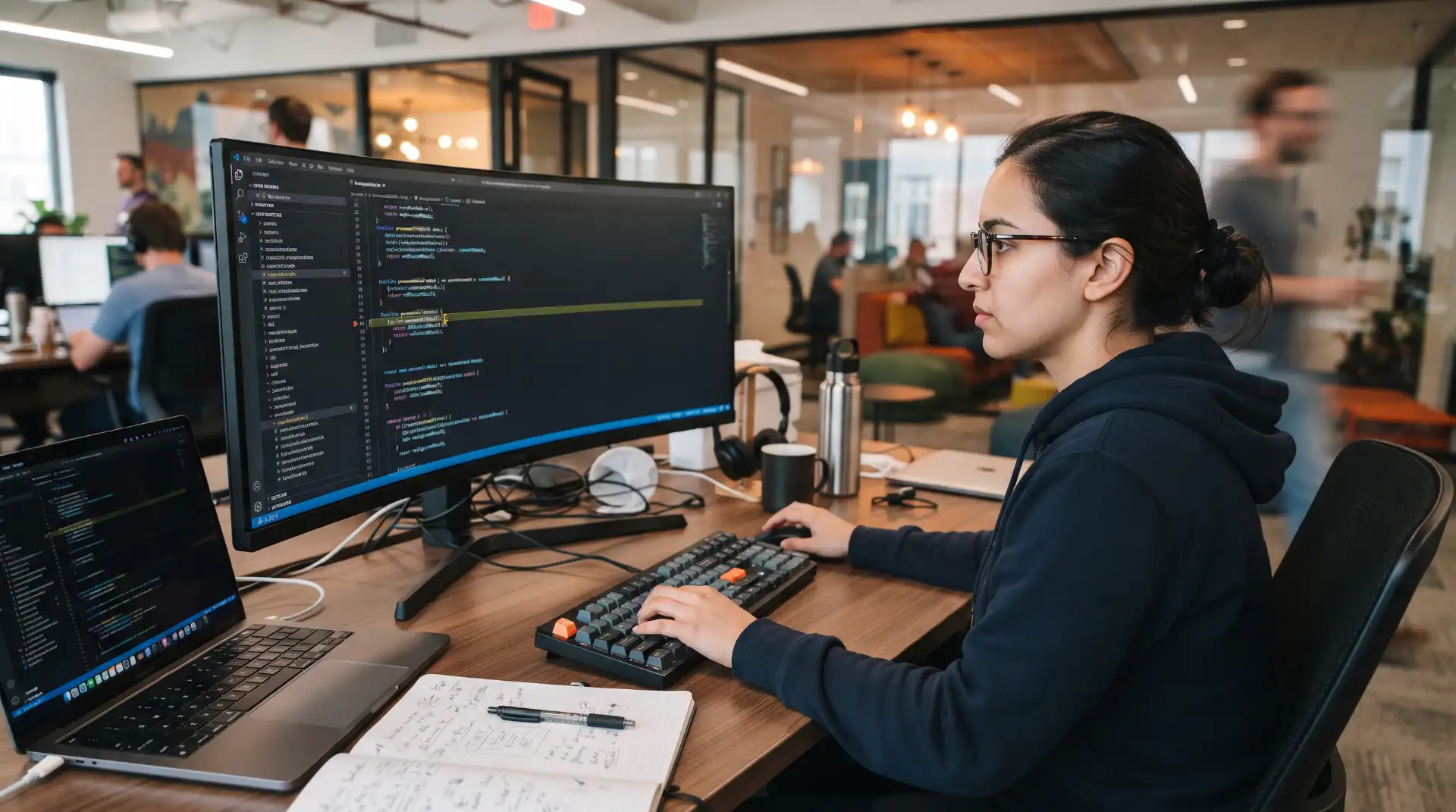
The practical issue is not simply whether generative AI was used. The more relevant question is what the human developer actually contributed.
A developer might use AI to suggest a routine function and then write the central architecture independently. Another might generate an initial prototype and spend weeks rewriting its code. A software team might ask an AI assistant to identify bugs without allowing the tool to generate expressive source code.
These examples do not necessarily produce the same copyright outcome.
Human-authored modifications, original source code, creative organization, and other protectable expression may qualify for copyright even when AI-generated material exists elsewhere in the same program.
The Copyright Office similarly allows registration of works combining human and AI-generated material when sufficient copyrightable human authorship is present. The claim generally needs to identify the human contribution and exclude more than minimal AI-generated material from the claimed authorship where appropriate.
For software companies, this creates a practical reason to document development.
Version histories, source-control repositories, design documentation, development tickets, pull requests, code reviews, and records showing substantial human revisions can help explain how a finished software product developed.
These records may become useful when a company needs to identify which parts resulted from human development and which portions came substantially from generative systems.
What If an Employee Uses AI to Create Software?
AI does not eliminate traditional employment ownership rules.
Under U.S. copyright law, a copyrightable work created by an employee within the scope of employment may qualify as a work made for hire. When that rule applies, the employer is generally treated as the author and copyright owner unless the parties have agreed otherwise in a signed written instrument.
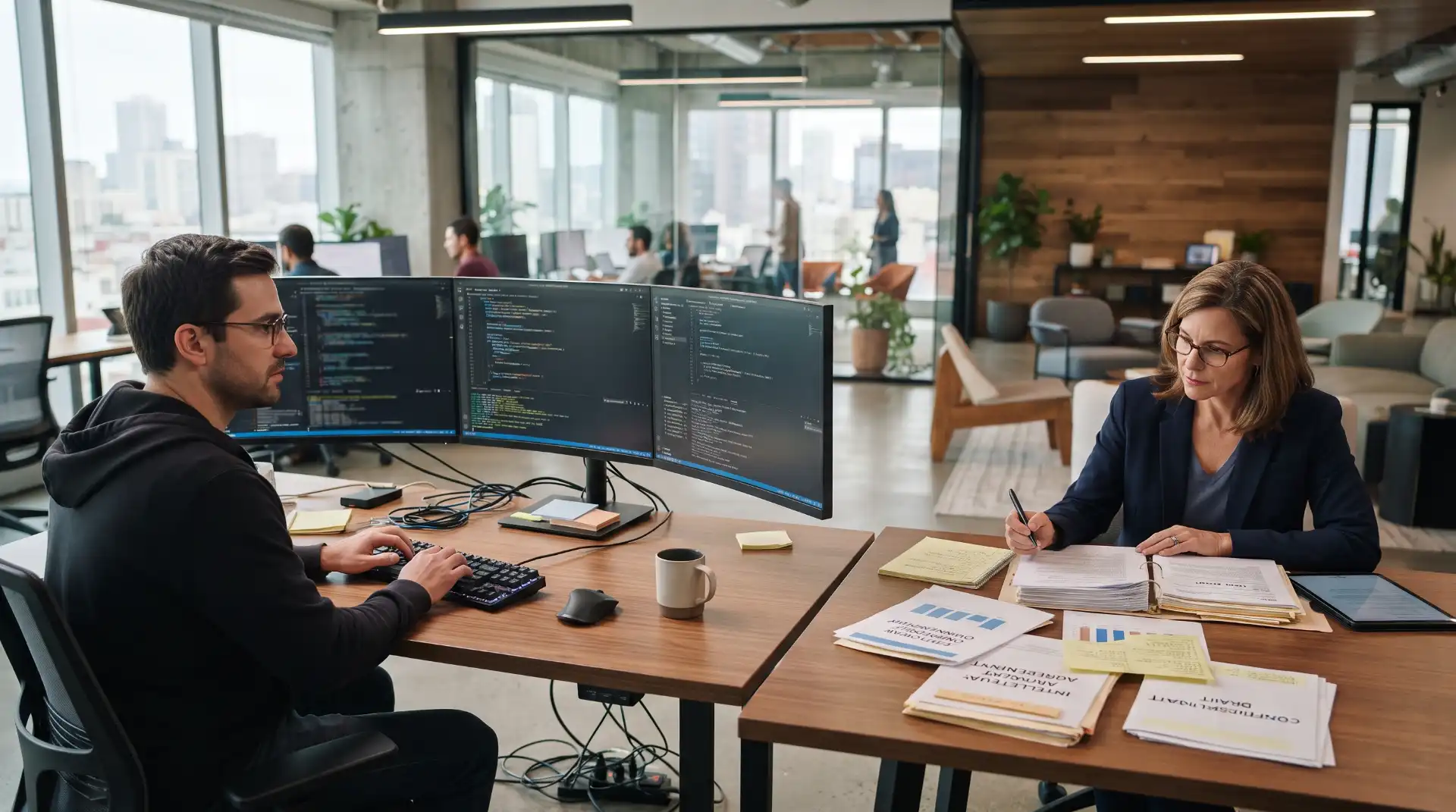
Suppose a software engineer works for a technology company and develops a new internal analytics application as part of normal job duties. The engineer uses a generative AI assistant to help create portions of the source code.
The employer may own copyright in qualifying human-authored portions created within the scope of employment under the work-made-for-hire doctrine.
The AI-generated portions create another layer of analysis. If particular portions contain no protectable human authorship, copyright ownership may not attach to those elements simply because the employer owns the rest of the software.
This makes the distinction between ownership and copyrightability particularly important.
A business can control software through contracts, confidentiality obligations, access restrictions, trade secret law, and other mechanisms even when every individual element is not independently copyrightable.
Independent Contractors Create Different Ownership Issues
Hiring a freelance programmer does not necessarily produce the same copyright result as having an employee create software.
The work-made-for-hire rules for independent contractors are narrower. The U.S. Copyright Office explains that specially commissioned works qualify as works made for hire only under specific statutory conditions, including that the work falls within one of the designated categories and that the parties expressly agree in a signed writing that the work is made for hire.
Software development agreements therefore frequently address ownership through express copyright assignment language rather than relying exclusively on work-made-for-hire status.
Generative AI makes careful contracting even more relevant.
A company hiring an outside development firm may want its agreement to address the contractor’s authority to use generative AI, ownership of human-authored code, disclosure of AI-generated components, third-party licenses, confidentiality requirements, and responsibility for reviewing generated code before delivery.
Without clear terms, disputes may arise regarding who owns the human-authored portions and what rights exist in other components.
AI Platform Terms May Also Matter
Copyright law is only one part of the ownership analysis.
Developers also interact with AI services under contractual terms. Those terms may address rights relating to prompts, outputs, data usage, confidentiality, account types, model training, indemnification, and restrictions on use.
A contract saying that a user receives particular rights in an output does not necessarily mean the output becomes copyrightable under federal law. Copyrightability and contractual rights are separate questions.
This distinction matters.
A platform might contractually grant users its rights, if any, in outputs. But if a particular AI-generated block of code lacks the human authorship necessary for copyright protection, a contractual ownership provision cannot necessarily create federal copyright where copyright law does not recognize one.
Developers and companies should therefore examine both the legal status of the code and the applicable platform agreement.
What Happens When Human and AI Code Are Mixed Together?
This may become the most common situation.
Modern software is rarely created through one continuous act of authorship. Programs routinely combine original code, open-source packages, frameworks, APIs, libraries, older company code, contractor contributions, and increasingly AI-generated suggestions.
The resulting application may therefore contain several different legal layers.
A developer might own copyright in original source code while having no copyright in underlying open-source components. A business might own employee-written modules while using third-party libraries under license. AI-generated portions might lack independent copyright protection while the human-authored selection, modifications, and other qualifying expression remain protectable.
The Copyright Office already recognizes similar distinctions for computer programs containing preexisting or third-party material. Registration of a new version generally covers new copyrightable authorship rather than automatically extending protection to previously published, previously registered, public-domain, or third-party material incorporated into the program.
Generative AI adds another category to that layered ownership structure.
Companies may increasingly need a software “rights map” showing which components are human-created, AI-assisted, open source, licensed, acquired, or produced by contractors.
Could AI-Generated Software Accidentally Include Someone Else’s Code?
Ownership of the output is not the only issue.
Software developers also need to think about infringement and licensing risks.
Generative AI models may produce code that resembles existing code, and developers should not assume that every output is legally unrestricted simply because it came from an AI service.
Traditional copyright analysis may still matter if generated code reproduces protected expression belonging to another party. Open-source licensing obligations may also become relevant when output contains or closely reproduces licensed source code.
This makes human review especially useful before generated code enters a commercial product.
Developers commonly review AI output for security vulnerabilities and technical errors. Legal review may need to become another part of that process, particularly for substantial generated blocks or code that appears unusually familiar.
For companies considering broader risks involving confidential information and AI systems, Legal Journal’s article on generative AI and trade secret protection for businesses provides additional context.
Trade Secrets May Protect Software Even When Copyright Is Uncertain
Copyright is not the only form of intellectual property relevant to software.
Some source code, algorithms, development methods, system configurations, internal tools, proprietary datasets, and technical processes may also receive protection as trade secrets when applicable legal requirements are satisfied.
This can become especially significant when AI-generated portions create uncertainty about copyright.
A company may still have commercial reasons to keep source code confidential even if certain elements do not qualify independently for copyright protection.
However, using public generative AI services can create separate confidentiality concerns. Developers who enter proprietary source code, confidential product designs, customer information, or internal technical documentation into outside AI systems may expose information in ways that conflict with company policies, contractual obligations, or trade secret protection practices.
Businesses using AI development tools may therefore need internal policies governing what developers can upload, which platforms are approved, and what information must remain within controlled environments.
This topic overlaps directly with broader questions surrounding AI-assisted inventions and intellectual property rights.
Can AI-Generated Software Be Patented?
Copyright and patent law protect different things.
Copyright generally protects qualifying expression in computer code, while patents may protect qualifying inventions that satisfy federal patent requirements.
The use of AI in software development therefore does not necessarily end the intellectual property analysis.
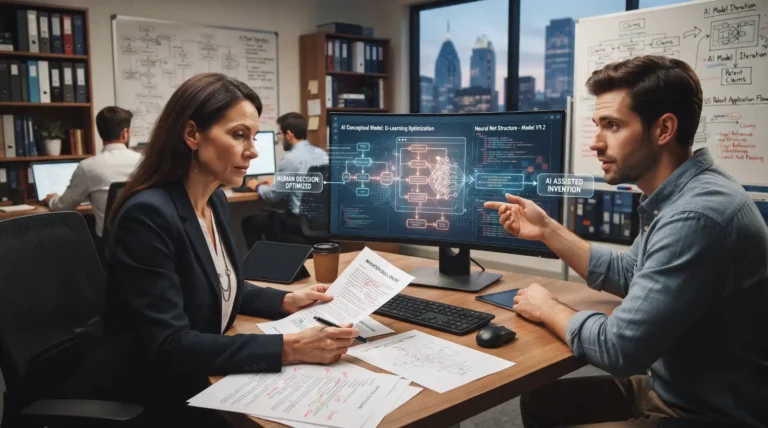
A software-based invention might potentially involve patentable subject matter even when portions of its code raise copyright questions. Patent law, however, also retains a human-centered requirement.
Current USPTO guidance states that the ordinary legal standard for inventorship applies to inventions involving AI and that only natural persons can qualify as inventors. AI systems themselves cannot be named as inventors on U.S. patent applications.
The distinction is important.
A company’s source code might contain limited copyrightable human expression while implementing a technical invention conceived by human inventors. Conversely, highly original human-written source code may qualify for copyright protection even when the underlying software does not meet patent requirements.
Companies developing valuable AI-assisted software may therefore consider copyright, patent, trade secret, trademark, and contractual protections separately rather than viewing “ownership” as a single legal question.
Contracts May Become More Important as AI Use Expands
Generative AI makes written agreements increasingly important because copyright law may not answer every commercial ownership question.
A software development contract can identify the parties’ expectations before a dispute occurs.
Companies may address ownership of human-created source code, rights in modifications, use of third-party software, AI-generated material, confidentiality, licensing obligations, deliverables, documentation, and intellectual property assignments.
Employee policies can address approved AI platforms and restrictions on entering confidential code into public tools.
Contractor agreements can address whether generative AI may be used and whether the contractor must identify AI-generated components.
Acquisition agreements can address whether a target company owns or has sufficient rights to the software it claims as an asset.
These issues become particularly important during investments and acquisitions. A buyer evaluating a software business may want to understand whether the company’s main product was created by employees, contractors, open-source components, AI systems, or some combination of all four.
Ownership documentation that once seemed routine may become a significant part of technology due diligence.
Copyright Registration May Require Disclosure of AI Material
Businesses seeking copyright registration should also pay attention to disclosure requirements.
The U.S. Copyright Office instructs applicants to identify human authorship and disclose AI-generated material when appropriate. Applicants may claim protection for human-created portions but should not claim copyright in material lacking human authorship.
For software, this could create practical questions about source code containing a mixture of human and AI contributions.
The Office’s guidance on computer programs already recognizes that registrations may cover only new copyrightable material while excluding preexisting, third-party, or public-domain content. AI-generated material introduces another possible limitation on the scope of a claim.
Businesses considering registration can review the U.S. Copyright Office’s official Copyright and Artificial Intelligence resources for current federal guidance.
Documentation can become especially valuable here. If a development team cannot determine which portions were generated by AI and which portions were written or substantially revised by humans, describing the scope of the copyright claim may become more difficult.
Businesses Should Track Human Contributions
Software development teams increasingly need records showing not merely what code exists, but how that code came into existence.
Source-control systems already provide much of this information. Commit histories may identify developers, revisions, additions, and changes. Code reviews can reveal substantial human decision-making. Technical documentation can establish architecture choices. Development tickets can show which problems engineers were solving.
When developers use AI coding assistants, companies might additionally document significant AI-generated components and subsequent human modifications.
The goal is not necessarily to record every autocomplete suggestion. AI assistance can range from minor spelling corrections to generation of entire modules. A proportionate documentation policy can focus on material uses that may affect ownership, confidentiality, security, or licensing.
This may help businesses preserve a clearer record of human authorship without making ordinary software development unnecessarily burdensome.
So Who Actually Owns AI-Generated Software?
There is no single owner in every situation.
For software written substantially by a human developer using AI merely as an assisting tool, copyright may protect the developer’s original expression. If that developer created the software as an employee within the scope of employment, the employer may own qualifying copyright under the work-made-for-hire doctrine.
If an independent contractor created the human-authored code, ownership may depend heavily on the contract and any copyright assignment.
If an AI system generated portions without sufficient human authorship, those particular portions may not qualify for copyright protection under the Copyright Office’s present framework.
If the application also includes open-source or third-party software, licenses may determine what the company can do with those components.
And if the software contains valuable confidential technology, trade secret protection and contracts may remain significant even where copyright coverage is limited.
The better question may therefore be not simply “Who owns the software?” but “Which rights does each party have in each part of the software?”
That question is more complicated, but it reflects how modern software products are actually built.
The Future of AI Software Ownership
Generative AI is unlikely to eliminate software copyright. Instead, it is changing what businesses need to document and analyze.
The U.S. Copyright Office currently maintains that existing copyright principles can address AI-assisted works without creating copyright protection for purely machine-generated material. It has also emphasized that using AI as a creative tool does not remove protection from qualifying human authorship.
For software developers, the key distinction is therefore between AI assistance and AI substitution.
When engineers remain responsible for architecture, expression, revisions, integrations, and other creative programming decisions, substantial human authorship may remain visible throughout the software.
When a developer provides a basic instruction and accepts extensive machine-generated code without meaningful creative involvement, the copyright analysis becomes less certain.
Companies adopting generative AI coding tools should therefore think beyond productivity. Ownership, confidentiality, licensing, copyright registration, employment agreements, contractor relationships, and intellectual property strategy may all be affected by the way those tools are used.
Generative AI may write more software in the years ahead, but under current U.S. copyright law, legally protectable authorship still starts with people.
This article provides general information about U.S. intellectual property law and does not constitute legal advice. Copyright and ownership questions depend on the specific facts, agreements, technology, and applicable law.