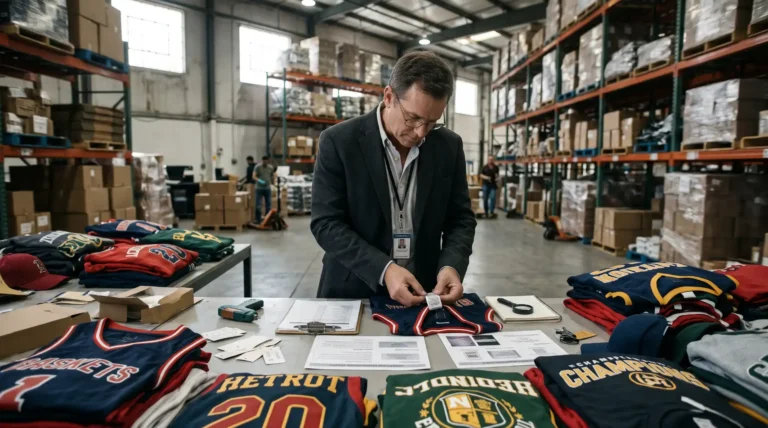
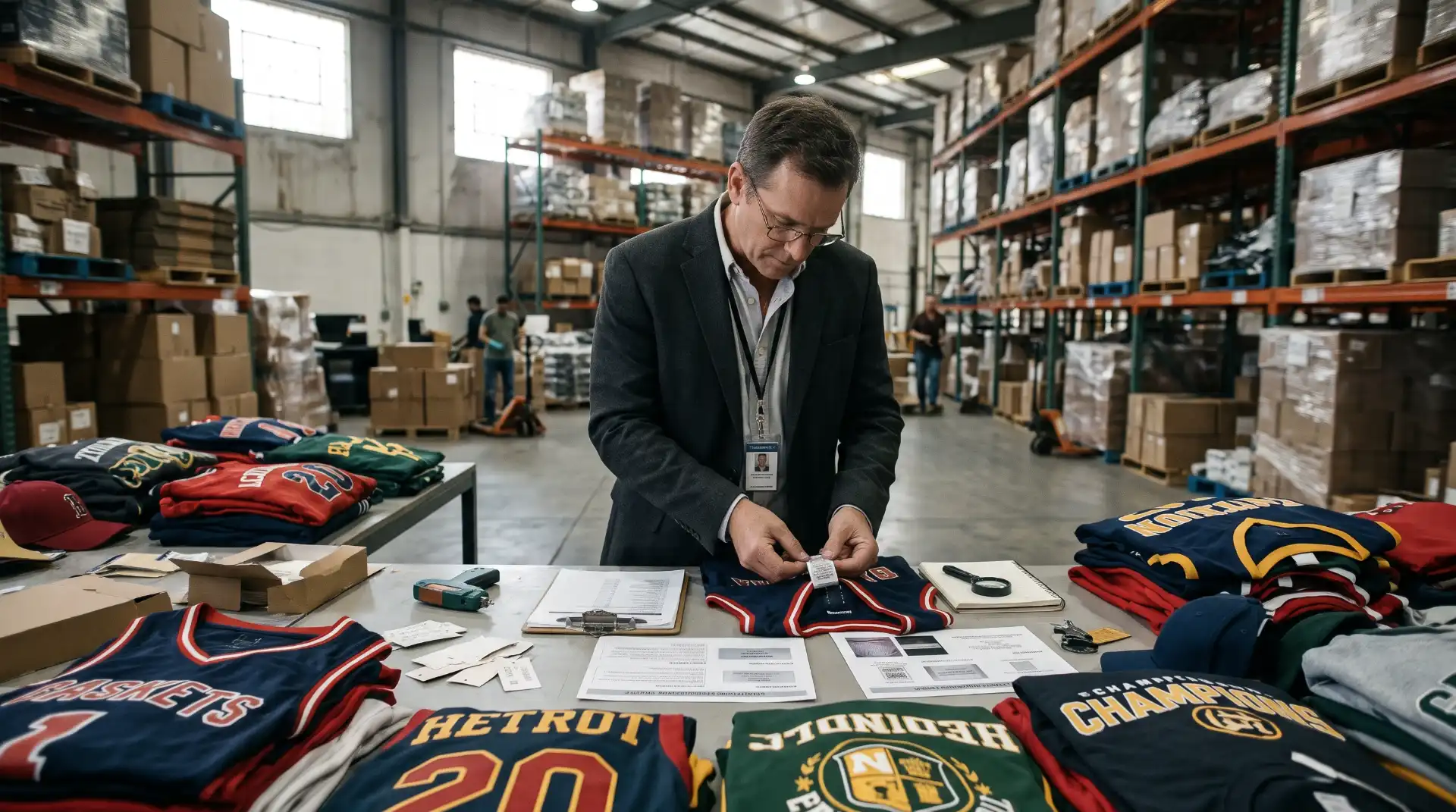
The Growing Legal Battle Over Counterfeit Sports Merchandise
Professional sports have developed into one of the most valuable commercial industries in the United States. Major leagues, professional teams, athletes, apparel manufacturers, equipment companies, and licensed merchandise distributors generate billions of dollars through products that allow fans to demonstrate their support for their favorite teams and players. From officially licensed jerseys and championship shirts to team hats, collectible trading cards, autographed memorabilia, and limited-edition footwear, sports merchandise represents an important connection between professional athletics and consumer culture.
However, the popularity of these products has also created a substantial market for counterfeit sports merchandise. Unauthorized manufacturers and sellers frequently reproduce team logos, league trademarks, player names, jersey designs, and other protected branding elements without permission. These products may be advertised through independent websites, social media accounts, online marketplaces, and international retail networks that make it increasingly difficult for intellectual property owners to identify the individuals responsible.
Counterfeit sports merchandise is not simply a matter of inexpensive clothing or unauthorized souvenirs. It raises important legal questions involving trademark infringement, copyright violations, unfair competition, false advertising, import restrictions, and criminal counterfeiting. It can also create financial consequences for legitimate businesses, professional sports organizations, athletes, and consumers who unknowingly purchase imitation products.
The legal challenges have become particularly important as online shopping continues to expand and international sporting events attract enormous commercial attention. The United States Trade Representative’s 2025 Review of Notorious Markets for Counterfeiting and Piracy, released in March 2026, specifically highlighted concerns involving counterfeit merchandise and sports broadcast piracy as the United States prepares to co-host the 2026 FIFA World Cup. The report identified 37 online markets and 32 physical markets associated with reported substantial counterfeiting or piracy activity.
United States Trade Representative
For sports brands, the challenge is no longer limited to identifying counterfeit products in physical stores. Companies must also monitor digital marketplaces, investigate suspicious sellers, protect their intellectual property across international borders, and develop enforcement strategies that can respond to rapidly changing online distribution networks.
Understanding how U.S. intellectual property law addresses counterfeit sports merchandise helps explain why professional sports organizations are investing in stronger brand protection programs and why online platforms are facing increased pressure to address unauthorized commercial activity.
1. What Qualifies as Counterfeit Sports Merchandise?
Counterfeit sports merchandise generally refers to products that intentionally imitate genuine licensed sports products by using protected trademarks, logos, labels, designs, or other identifying features without authorization. These products are frequently presented as authentic merchandise or designed to create the impression that they have been approved by a professional sports organization, team, athlete, or authorized manufacturer.
Common examples include imitation professional football jerseys, basketball uniforms, baseball caps, soccer shirts, championship apparel, team jackets, athletic shoes, and collectible items bearing unauthorized branding.
A counterfeit product may reproduce a team’s official logo almost exactly, copy the design of an authentic jersey, or display a player’s name and number in a way that suggests an official connection with the league. Some manufacturers also imitate product tags, holographic labels, packaging, and authentication certificates to make their products appear legitimate.
However, not every inexpensive sports product is counterfeit. A generic shirt displaying sports-related colors, a fan-created design, or an independently manufactured item may be perfectly lawful if it does not violate protected intellectual property rights or create an unlawful impression of sponsorship or affiliation.
The distinction depends on the specific intellectual property involved, how the product is marketed, whether protected marks are being used without authorization, and whether consumers are likely to be confused about the product’s origin or approval.
Counterfeit Products Versus Unlicensed Merchandise
The terms counterfeit and unlicensed merchandise are sometimes used interchangeably, but they do not necessarily describe the same legal situation.
Counterfeit merchandise generally involves unauthorized use of a protected mark that is identical or substantially indistinguishable from a registered trademark and is likely to cause confusion, mistake, or deception. This is particularly important under federal trademark and criminal counterfeiting laws.
Unlicensed merchandise is a broader category. It may involve products that use team names, athlete likenesses, logos, or copyrighted artwork without permission, but the exact legal analysis depends on the intellectual property rights involved.
For example, an independent manufacturer might sell a shirt with a design that refers to a professional sports team without reproducing its registered logo. Whether that product violates the law depends on its presentation, the applicable trademark rights, copyright protection, publicity rights, and other relevant circumstances.
An item can also be unauthorized without necessarily meeting the narrower legal definition of a counterfeit product.
This distinction matters because trademark counterfeiting can trigger particularly serious remedies and criminal penalties. Other unauthorized uses may instead require a more detailed infringement analysis.
Why Sports Merchandise Is Especially Vulnerable
Sports merchandise is attractive to counterfeiters because professional teams and athletes have highly recognizable identities. Fans often want products associated with championship victories, major tournaments, famous players, and important sporting events.
Limited-edition merchandise creates additional opportunities for unauthorized sellers. When an official championship jersey sells out, consumers may turn to unfamiliar online stores offering apparently identical products. Counterfeit manufacturers can exploit the urgency surrounding major games and tournaments by advertising imitation products before legitimate retailers can replenish their inventory.
International sporting events can create similar problems. During tournaments, counterfeiters may quickly produce national team shirts, scarves, caps, flags, and commemorative clothing using tournament branding and team-related designs.
These products can appear across multiple marketplaces at the same time, making enforcement difficult even when a rights holder successfully removes individual listings.

2. How U.S. Trademark Law Protects Professional Sports Brands
Trademark law is one of the most important legal tools used to fight counterfeit sports merchandise in the United States.
A trademark identifies the source of goods or services and helps consumers distinguish one company’s products from another. In professional sports, trademarks can include team names, league names, distinctive logos, slogans, symbols, and other brand identifiers.
Sports organizations frequently protect these assets through federal trademark registrations, licensing agreements, and ongoing brand enforcement programs.
The Lanham Act and Sports Merchandise Counterfeiting
The primary federal trademark statute is the Lanham Act, which provides legal protection against unauthorized uses of trademarks that create confusion about the source, sponsorship, or affiliation of commercial products.
Under 15 U.S.C. § 1114, unauthorized commercial use of a reproduction, counterfeit, copy, or colorable imitation of a registered trademark may constitute infringement when the use is likely to cause confusion, mistake, or deception.
This provision is particularly relevant to counterfeit jerseys, caps, jackets, and other merchandise bearing registered team or league marks.
Consider a hypothetical manufacturer that produces thousands of basketball jerseys displaying a professional team’s registered logo without obtaining permission. The manufacturer then sells the jerseys through an online marketplace while describing them as official team merchandise.
The trademark owner may have grounds to pursue an infringement claim because the unauthorized use can mislead consumers into believing that the products are manufactured, licensed, or approved by the legitimate rights holder.
The analysis can become more complicated when sellers use slightly modified logos, altered team names, or product descriptions designed to avoid automated trademark detection. Even when a mark is not an exact copy, a confusingly similar commercial presentation may still raise infringement concerns.
Trademark protection is therefore not limited to preventing the exact duplication of a logo. It can also address unauthorized branding practices that create a misleading commercial association.
Federal Registration and Trademark Enforcement
Federal trademark registration can provide important advantages to sports organizations and merchandise manufacturers.
Registration creates a public record of ownership and provides statutory benefits that can strengthen enforcement efforts. It can also help rights holders establish their claims when dealing with online platforms, customs authorities, and courts.
Professional sports organizations commonly protect several categories of marks. These may include league names, individual team names, official logos, championship identifiers, and certain promotional phrases.
Manufacturers and distributors may also own trademarks associated with their own apparel brands and product lines.
For example, an officially licensed manufacturer might have trademark rights in its brand name while a professional team owns the rights to its team logo. The relationship between these rights is usually defined through licensing agreements that authorize the manufacturer to produce and distribute approved merchandise.
An unauthorized seller cannot simply reproduce the same branding because the original product is popular or because the seller believes the logo is widely recognizable.
Trademark owners should maintain accurate registration records, monitor unauthorized commercial activity, and ensure that their licensing arrangements clearly identify which companies are authorized to manufacture and distribute specific products.
3. Criminal Counterfeiting Laws and Potential Penalties
Civil trademark litigation is not the only enforcement option available to sports brands. Certain counterfeiting activities can also lead to federal criminal prosecution.
One of the most important statutes is 18 U.S.C. § 2320, which addresses trafficking in counterfeit goods or services.
The law generally prohibits intentional trafficking in goods or services using counterfeit marks, as well as certain counterfeit labels, patches, stickers, packaging, and related materials.
For a criminal violation, the government must establish the required statutory elements, including the defendant’s knowledge and intent. A business that unknowingly purchases a mislabeled product is not automatically subject to criminal liability merely because the merchandise later turns out to be counterfeit.
The distinction between accidental involvement and knowing participation is important when evaluating potential criminal exposure.
What Conduct Can Lead to Criminal Liability?
Criminal counterfeiting investigations may involve manufacturers, wholesalers, importers, distributors, and sellers who knowingly participate in commercial operations involving counterfeit goods.
For example, investigators might identify a manufacturer producing imitation professional football jerseys, a wholesaler distributing those products to multiple sellers, and an online business advertising them as genuine licensed merchandise.
Depending on the evidence, each participant’s role may become relevant to a broader investigation.
The federal statute also addresses trafficking in counterfeit labels and other materials intended to accompany goods. This is important because counterfeit operations do not always manufacture the entire product themselves. Some operations specialize in producing imitation tags, patches, packaging, and authentication materials that other businesses attach to unauthorized merchandise.
The government may investigate the financial transactions, shipping records, manufacturing arrangements, communications, and online sales activity associated with the operation.
Potential Criminal Penalties
Federal criminal penalties for trafficking in counterfeit goods can be substantial. Under 18 U.S.C. § 2320, the maximum penalties depend on the applicable circumstances, including whether the offense is a first or subsequent conviction and whether the conduct involves specified aggravated categories.
For an ordinary first offense, the statute provides for imprisonment of up to 10 years for an individual and fines under the applicable statutory provisions. Certain subsequent offenses can carry higher maximum prison terms.
These penalties demonstrate that commercial counterfeiting can be treated as a serious federal crime rather than simply a disagreement between competing businesses.
Criminal investigations are generally handled by federal law enforcement and prosecutors when the facts support federal jurisdiction and the statutory requirements.
Sports brands may assist investigators by providing trademark registrations, product authentication information, evidence of unauthorized sales, and documentation demonstrating the commercial impact of the counterfeit operation.
4. Copyright Law and the Protection of Sports Merchandise Designs
Trademark law is central to counterfeit merchandise enforcement, but copyright law can also protect important creative elements used in sports products.
Copyright generally protects original works of authorship fixed in a tangible medium of expression. In the sports merchandise industry, this can include original illustrations, graphic artwork, photographs, promotional designs, and certain decorative elements.
A jersey’s team logo may be protected through trademark law, copyright law, or both, depending on the nature of the artwork and the applicable rights.
Copyright Protection for Team Artwork and Graphics
Professional sports organizations frequently commission designers and creative agencies to develop visual materials used in merchandise and advertising.
These works can include illustrated championship graphics, player portraits, mascot artwork, commemorative designs, and promotional photographs.
If a counterfeit manufacturer copies protected artwork onto unauthorized shirts, posters, or other merchandise, the reproduction may create copyright infringement concerns.
Copyright protection is distinct from trademark protection. A trademark generally identifies commercial source, while copyright protects qualifying original expression.
A single sports product can contain multiple layers of intellectual property. For instance, a championship shirt might display a registered league trademark, an original commemorative illustration, and a photograph of an athlete. Each component may involve different ownership arrangements and legal protections.
Copyright Does Not Automatically Protect Every Sports Idea
Not every element associated with sports merchandise qualifies for copyright protection.
Basic facts, names, short phrases, and familiar concepts are not automatically protected by copyright. Similarly, a general idea for a sports-themed shirt does not become exclusively owned simply because one manufacturer develops a design around it.
The actual expression of an idea may receive protection, but copyright law does not generally give someone ownership over an entire category of sports-related concepts.
This distinction is important for businesses that want to develop original merchandise without copying protected artwork or misleading consumers about sponsorship.
Independent designers should create original graphics, obtain appropriate licenses for third-party materials, and retain documentation establishing ownership of their creative work.
5. How Online Marketplaces Have Changed Counterfeit Merchandise Enforcement
The growth of online marketplaces has transformed how counterfeit sports merchandise reaches American consumers.
Traditional counterfeiting operations often relied on physical stores, informal distributors, street vendors, and wholesale networks. Today, sellers can advertise products to thousands of potential customers without maintaining a conventional retail location.
Online platforms provide access to domestic and international buyers, while social media advertising can rapidly increase the visibility of unauthorized products.
A counterfeit jersey might be listed by an overseas seller, promoted through a social media account, paid for through a digital payment service, and shipped directly to a consumer in the United States.
The problem of counterfeit products is closely connected to the broader issue of online brand impersonation. Businesses that discover unauthorized sports merchandise should also consider whether sellers are operating imitation websites designed to deceive customers. Legal Journal examines these risks in its article on Domain Name Disputes and Cybersquatting: How Brands Can Fight Impersonation Sites, which explains how trademark owners can respond to fraudulent websites and unauthorized commercial activity.
This structure creates enforcement challenges because the seller, manufacturer, marketplace operator, payment processor, and shipping provider may be located in different jurisdictions.
The Difficulty of Identifying Individual Sellers
Many counterfeit sellers operate through temporary storefronts or accounts that can disappear shortly after enforcement action.
Some businesses use multiple seller accounts, different product descriptions, altered photographs, or slightly modified brand names to avoid detection.
When one listing is removed, another may appear under a different account.
This repeated activity makes enforcement more complicated than simply submitting a trademark complaint against a single online seller.
Sports organizations must often identify patterns across multiple listings and determine whether apparently unrelated storefronts are connected to the same manufacturer or distributor.
Investigators may compare product photographs, shipping information, seller contact details, pricing patterns, packaging, and other available evidence.
Why Marketplace Enforcement Is Not Always Simple
Online platforms operate under different policies and legal frameworks. Their responsibilities can depend on the type of service they provide, the nature of the alleged infringement, the applicable law, and the facts of each dispute.
A marketplace may provide a platform for third-party sellers without manufacturing or directly owning the products being advertised.
However, that does not mean every platform is automatically protected from all forms of liability.
The legal analysis can involve trademark infringement, contributory liability theories, direct participation, false advertising, contractual obligations, and applicable statutory defenses.
The question is not simply whether a counterfeit item appeared on a website. It is also necessary to examine the platform’s conduct, knowledge, control, commercial involvement, and the legal requirements of the specific claim.
For sports brands, the most practical approach often combines marketplace reporting procedures with independent investigations and, where appropriate, litigation.
6. The Role of Online Marketplace Policies and Intellectual Property Complaint Systems
Major e-commerce platforms have developed intellectual property reporting systems that allow rights holders to submit complaints about suspected counterfeit products.
These systems typically require information identifying the protected trademark or copyrighted work, the allegedly infringing listing, and evidence supporting the complaint.
A brand may submit a trademark registration number, product photographs, links to authorized merchandise, and an explanation of how the disputed listing uses the protected mark.
The marketplace can then review the complaint under its internal policies and applicable legal obligations.
Why Detailed Evidence Matters
A vague complaint may be difficult for a marketplace to evaluate.
For example, a rights holder that reports a product simply because it resembles an official jersey may not provide enough information to demonstrate infringement.
A stronger report identifies the protected trademark, explains the unauthorized use, identifies the specific product listing, and includes supporting documentation.
Sports organizations can also provide examples of genuine products and explain differences between authentic merchandise and known counterfeits.
Some companies maintain specialized intellectual property enforcement teams that regularly monitor marketplace listings and submit reports.
Repeat-Infringer Problems
Removing individual listings does not necessarily eliminate the underlying counterfeit operation.
A seller may reopen an account, use a different business name, or move to another platform.
For this reason, rights holders may request broader enforcement measures when evidence suggests repeated violations.
These measures can include account restrictions, seller suspensions, removal of related listings, preservation of relevant records where legally appropriate, and cooperation with law enforcement.
Marketplace policies differ, and rights holders should not assume that a successful complaint on one platform automatically results in action on another.
7. The Importance of the 2026 FIFA World Cup and Major Sporting Events
Major international sporting events create significant commercial opportunities for licensed merchandise manufacturers.
The 2026 FIFA World Cup is particularly important because the United States, Canada, and Mexico are jointly hosting the tournament. With millions of fans following the competition and purchasing related products, demand for team apparel and commemorative merchandise is substantial.
However, major tournaments also create favorable conditions for counterfeiters.
Unauthorized sellers may produce imitation national team jerseys, scarves, caps, flags, tournament merchandise, and other products designed to capitalize on public excitement.
The timing of these sales can make enforcement especially difficult. A counterfeit product can appear online during a major match and generate substantial sales before the rights holder has time to investigate and submit complaints.
Tournament Branding and Unauthorized Merchandise
Sports tournaments often involve extensive trademark licensing arrangements.
Official competition names, logos, mascots, trophy designs, and certain promotional materials may be protected through registered trademarks, copyright, or other applicable intellectual property rights.
Unauthorized commercial use of these assets can create infringement concerns.
For example, a seller that reproduces an official tournament logo on thousands of shirts without permission may face a different legal situation from an independent seller offering a generic soccer shirt in national team colors.
The distinction depends on the protected rights and the commercial presentation of the product.
Tournament organizers and licensed manufacturers can reduce confusion by publishing authorized retailer information, educating consumers about official products, and monitoring suspicious merchandise advertisements.
International Enforcement and Cross-Border Sales
The international nature of major sports events makes cross-border enforcement particularly important.
A product manufactured overseas may be advertised through an international marketplace and shipped to consumers in multiple countries.
U.S. rights holders may need to coordinate with customs authorities, foreign investigators, platform operators, and local legal representatives.
This process can be challenging because intellectual property laws and enforcement procedures differ between jurisdictions.
A trademark registration in the United States does not automatically provide identical protection in every foreign country.
Companies involved in international merchandise distribution should evaluate trademark protection in important manufacturing, transit, and sales markets.
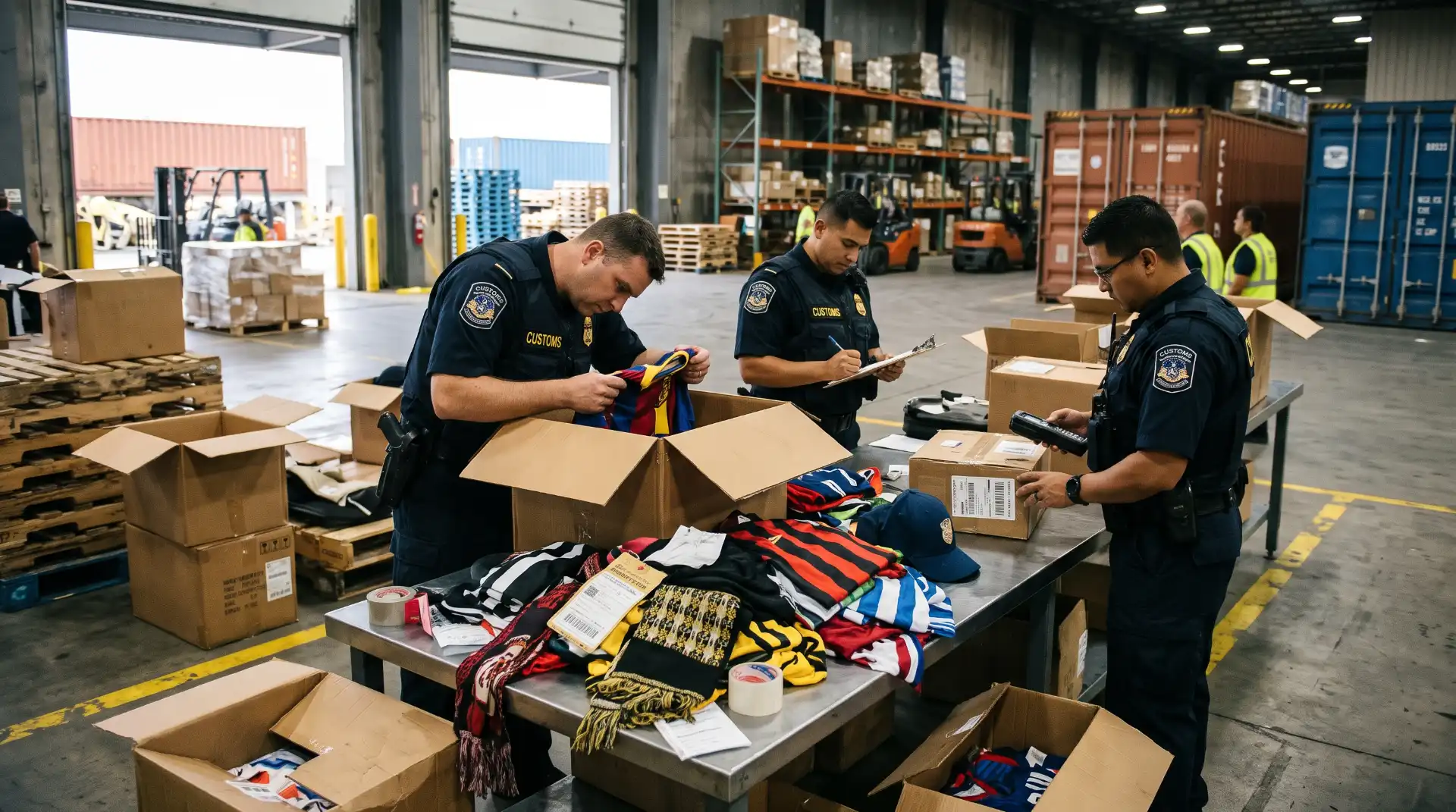
8. How U.S. Customs and Border Protection Helps Stop Counterfeit Sports Products
U.S. Customs and Border Protection plays an important role in preventing certain counterfeit products from entering the American market.
Imported merchandise may be examined at ports of entry when authorities identify possible intellectual property violations.
CBP has authority to detain, seize, forfeit, and ultimately destroy certain imported merchandise that infringes protected trademarks or copyrights when the applicable statutory and regulatory requirements are met.
Rights holders can strengthen border enforcement by recording eligible intellectual property rights with CBP.
Recording Trademarks and Copyrights With CBP
A sports organization that owns valuable trademarks may seek to record its eligible registrations with CBP’s intellectual property enforcement program.
This gives customs officials access to information that can help identify suspicious imported products.
For example, a registered professional sports team might provide details about its protected logo, authorized merchandise, known counterfeit characteristics, and legitimate licensing arrangements.
These materials can help authorities evaluate imported products that appear to use the protected mark without permission.
CBP’s e-Recordation program is particularly relevant to companies that face recurring imports of counterfeit products.
Rights holders can review the agency’s official guidance through the U.S. Customs and Border Protection Intellectual Property Rights program.
Why Border Enforcement Is Important
Online sellers may advertise counterfeit merchandise to American consumers even when the products are manufactured abroad.
Border enforcement can interrupt this distribution process before products reach warehouses, fulfillment centers, or individual customers.
However, not every suspicious product will automatically be seized. Customs enforcement depends on the applicable rights, available information, examination procedures, and legal requirements.
Rights holders should therefore treat CBP enforcement as one component of a larger intellectual property protection strategy rather than a complete solution.
Companies should combine border protection with online monitoring, seller investigations, trademark registration, and appropriate civil or criminal enforcement measures.
9. How Sports Brands Investigate and Identify Counterfeit Sellers
Effective counterfeit enforcement begins with identifying unauthorized commercial activity.
Sports brands increasingly rely on a combination of legal teams, investigators, product authentication specialists, and digital monitoring systems.
The goal is to identify counterfeit products, determine who is responsible, preserve relevant evidence, and select an enforcement strategy that is proportionate to the violation.
Digital Marketplace Monitoring
Automated monitoring tools can help brands identify suspicious listings across online marketplaces.
These systems may search for protected team names, trademarked logos, product descriptions, and images resembling authentic merchandise.
Some tools use image recognition to compare listing photographs against databases of genuine products.
Although automated monitoring can identify large numbers of potentially suspicious listings, human review remains important.
A product that appears visually similar to official merchandise is not necessarily counterfeit. Some legitimate products may use similar colors, common sports imagery, or independently created designs.
Investigators must evaluate the specific intellectual property rights and commercial circumstances involved.
Purchasing Suspected Counterfeit Products
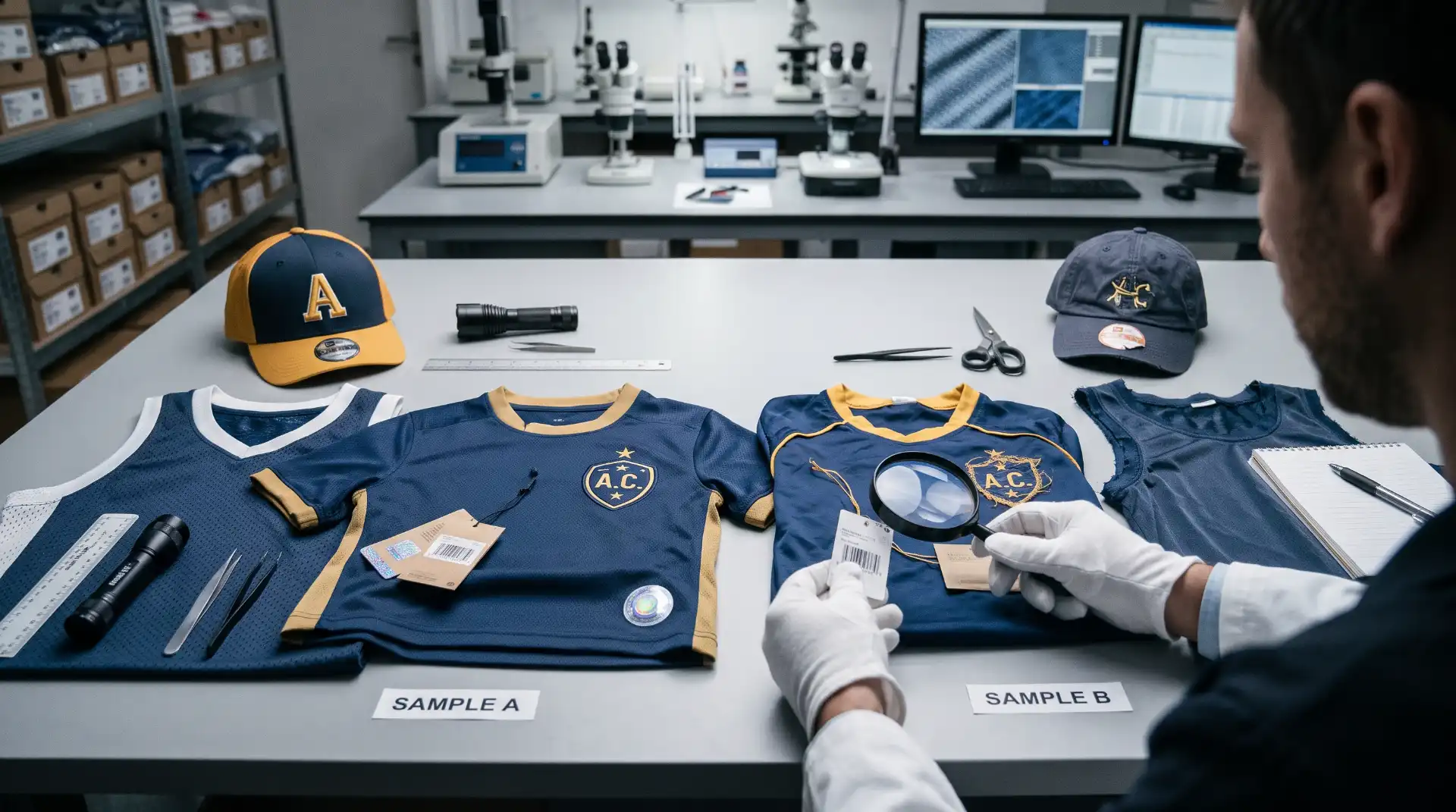
In some investigations, rights holders or authorized investigators purchase suspected counterfeit products to examine them.
The purchased items can provide evidence concerning:
Product construction and material quality.
Labels, tags, and packaging.
Unauthorized use of trademarks.
Manufacturing inconsistencies.
Shipping information.
Seller representations.
Authentication features.
This information can help establish whether a product is counterfeit and may assist in identifying the supply chain.
Evidence should be collected and preserved carefully. Investigators may need to retain order confirmations, receipts, shipping labels, photographs, communications, and records showing how the product was advertised.
Identifying Connections Between Sellers
A counterfeit operation may involve multiple storefronts that appear unrelated.
However, investigators may discover that the accounts use the same contact information, product images, packaging, shipping arrangements, or payment details.
These similarities can provide useful investigative leads.
For example, several online sellers might advertise identical championship jerseys using different business names. If the products also arrive in matching packaging from the same distribution location, investigators may have reason to examine whether the sellers share a common supplier.
The existence of similar products alone does not prove that multiple sellers are legally connected. Additional evidence is necessary before drawing conclusions about common ownership or coordinated activity.
10. Civil Lawsuits and Legal Remedies Against Counterfeit Merchandise Sellers
When informal enforcement efforts fail, intellectual property owners may consider civil litigation.
Trademark owners can pursue claims under the Lanham Act when the required legal elements are satisfied.
Depending on the circumstances, copyright claims, unfair competition claims, and related causes of action may also be available.
Civil litigation can serve several purposes. It may stop ongoing infringement, recover financial losses, prevent future unauthorized sales, and establish legal accountability.
Injunctions Against Unauthorized Sellers
One of the most important remedies in intellectual property litigation is an injunction.
A court may issue preliminary or permanent injunctive relief when the applicable legal requirements are met.
An injunction can prohibit a defendant from continuing specified infringing activities.
For example, a sports organization that demonstrates the necessary grounds for relief may seek an order preventing a seller from manufacturing or distributing merchandise bearing unauthorized team trademarks.
In appropriate cases, courts may also address inventory, counterfeit labels, packaging, and other materials connected with the infringement.
Injunctions are especially important when unauthorized sellers continue operating after receiving formal notices.
Monetary Damages
The Lanham Act provides several potential remedies for trademark violations.
Depending on the claim and circumstances, a successful plaintiff may seek actual damages, the defendant’s profits, costs, and attorney’s fees in exceptional cases.
In qualifying counterfeit-mark cases involving registered trademarks, the law also provides for statutory damages.
Under 15 U.S.C. § 1117(c), a plaintiff may elect statutory damages instead of actual damages and profits, subject to the statutory requirements.
The ordinary statutory range for qualifying counterfeit-mark violations is $1,000 to $200,000 per type of goods or services sold, offered for sale, or distributed. If the court finds that the use was willful, the maximum may increase to $2 million per type of goods or services.
These figures are statutory limits, not automatic awards. Courts determine appropriate amounts based on the circumstances and applicable legal standards.
The potential financial exposure can be significant for businesses engaged in large-scale counterfeiting.
Destruction of Counterfeit Merchandise
Courts may also order the destruction or other appropriate disposition of counterfeit goods, labels, packaging, and related materials under applicable legal provisions.
This remedy can prevent seized merchandise from returning to the market through another seller or distribution channel.
For sports brands, destroying counterfeit inventory can be an important part of protecting consumers and preventing repeated infringement.
11. The Difference Between Counterfeit Merchandise and Gray-Market Products
Not every sports product sold outside an authorized retail channel is counterfeit.
Gray-market merchandise, sometimes called parallel-import merchandise, generally refers to genuine products that are imported or resold through distribution channels that the brand owner did not authorize for the particular market.
This distinction is important because counterfeit goods and genuine gray-market products can raise different legal questions.
For example, a genuine team jersey manufactured by an authorized company for a foreign market might be resold by an independent importer in the United States.
The jersey may be authentic even if the importer is not part of the manufacturer’s preferred distribution network.
By contrast, an imitation jersey displaying a counterfeit trademark is not transformed into genuine merchandise merely because the seller describes it as an imported product.
Why Gray-Market Disputes Can Be Complicated
The legal treatment of gray-market products depends on several factors, including the identity of the trademark owner, the relationship between domestic and foreign products, material differences, quality controls, and applicable trademark doctrines.
Some gray-market imports may be lawful, while others may create trademark infringement concerns.
Sports brands should therefore avoid treating every unauthorized distributor as a counterfeiter.
A business that sells genuine merchandise outside an approved distribution arrangement may present a different legal problem from a manufacturer producing imitation products with counterfeit team logos.
Accurate classification helps companies avoid unnecessary disputes and focus enforcement resources on conduct that actually violates their intellectual property rights.
12. Consumer Protection: How Fans Can Recognize Counterfeit Sports Merchandise
Consumers are an important part of the fight against counterfeit sports products.
Fans who knowingly or unknowingly purchase imitation merchandise can support unauthorized sellers and create additional demand for counterfeit products.
Some counterfeit items may look convincing in online photographs but have poor construction, inaccurate colors, low-quality printing, or incorrect labeling.
International sports merchandise distribution creates additional trademark challenges for American companies that manufacture products overseas or work with foreign licensing partners. Protecting a brand in the United States does not automatically establish equivalent rights in every foreign market. Companies should understand the differences between national trademark systems, registration requirements, and enforcement procedures. For additional analysis, see Legal Journal’s article on China’s New Trademark Law and What It Means for U.S. Brands Doing Business Overseas.
Other sellers deliberately make their products appear authentic by using professional photographs and descriptions copied from legitimate retailers.
Warning Signs When Shopping Online
Consumers should pay attention to unusually low prices, unfamiliar sellers, inconsistent product descriptions, and websites that provide little information about their business operations.
A heavily discounted championship jersey advertised as authentic shortly after a major sporting event may deserve additional scrutiny.
However, price alone does not establish that a product is counterfeit. Genuine merchandise can be discounted through authorized sales, clearance events, and legitimate resale arrangements.
Consumers should also check whether the seller is listed as an authorized retailer by the relevant team, league, or manufacturer.
The United States Patent and Trademark Office provides consumer information about identifying counterfeit goods, including warning signs involving pricing, packaging, and purchasing locations. Its guidance is available through the USPTO’s counterfeit goods information.
What to Do After Purchasing a Counterfeit Product
Consumers who believe they purchased counterfeit sports merchandise should preserve the original order confirmation, payment receipt, seller information, product photographs, packaging, and relevant communications.
They can contact the marketplace or payment provider to ask about available dispute and refund procedures.
Consumers may also report suspected counterfeit activity to the relevant brand owner.
When the purchase involves possible fraud, identity theft, or other criminal conduct, additional reporting options may be available depending on the circumstances.
It is important not to assume that every disappointing or low-quality product is counterfeit. A product may be defective, misrepresented, unauthorized, or simply different from what the customer expected. The available evidence helps determine the appropriate response.
13. The Legal Risks for Independent Sellers and Small Businesses
Small businesses and independent online sellers may underestimate the legal consequences of offering sports merchandise without appropriate authorization.
Some sellers assume that purchasing products from a wholesaler automatically gives them permission to use every trademark displayed on the merchandise.
That assumption can be dangerous.
A seller may still face legal exposure if the products are counterfeit or if the seller participates in unauthorized commercial activity that violates applicable intellectual property rights.
Due Diligence Before Selling Sports Merchandise
Businesses should establish procedures for verifying suppliers and merchandise before offering sports products to consumers.
This includes requesting invoices, checking supplier credentials, confirming product authenticity, and examining whether the supplier has legitimate distribution rights.
Sellers should be particularly cautious when suppliers offer large quantities of popular team merchandise at unusually low prices without reliable documentation.
A wholesaler’s assurance that merchandise is authentic is not always sufficient.
Businesses should retain transaction records, product specifications, supplier information, and licensing documentation where applicable.
Avoiding Misleading Advertising
Product descriptions should accurately explain whether merchandise is officially licensed, independently produced, vintage, or secondhand.
A seller should not describe a product as official team merchandise unless the claim is accurate and supported.
Misleading product photographs, unauthorized brand references, and false statements about league approval can create additional legal problems.
Businesses should also avoid using official logos in advertising when doing so creates an unauthorized impression of sponsorship or commercial affiliation.
When a seller is uncertain whether a particular design or product is lawful, obtaining legal advice before launching the listing is generally safer than attempting to resolve an infringement complaint after sales have begun.
14. How Athletes and Professional Teams Protect Their Commercial Identity
Sports merchandise is closely connected to the commercial identities of professional athletes and teams.
A player’s name, number, photograph, signature, or likeness may be incorporated into licensed products through contractual arrangements.
These arrangements can involve multiple parties, including athletes, agents, professional teams, leagues, manufacturers, and licensing organizations.
Counterfeiters may attempt to exploit this commercial value by selling unauthorized products featuring recognizable athletes.
Publicity Rights and Athlete Likenesses
The right of publicity generally concerns the commercial use of an individual’s name, image, likeness, or other identity-related attributes.
In the United States, publicity rights are primarily governed by state law, and the applicable protections vary by jurisdiction.
For example, unauthorized use of an athlete’s photograph to advertise a product may raise publicity-rights concerns, depending on the circumstances.
A seller that reproduces a player’s image on a commercial product without authorization may face potential legal claims beyond ordinary trademark infringement.
However, the legal analysis can be complicated by First Amendment protections, news reporting, artistic expression, and other applicable defenses.
Not every reference to an athlete is unlawful.
A journalist discussing a player, a fan writing a commentary article, and a manufacturer selling unauthorized commercial merchandise may be treated differently under the law.
Licensing Agreements and Commercial Control
Professional athletes and sports organizations frequently negotiate agreements governing how their identities and branding can be used.
These agreements can define authorized merchandise categories, geographic markets, product quality standards, advertising permissions, and royalty arrangements.
Counterfeit merchandise can undermine these agreements by allowing unauthorized businesses to profit from commercial rights they do not own.
For this reason, sports brands often coordinate their trademark enforcement activities with athlete representatives and licensed manufacturers.
15. Technology and the Future of Counterfeit Sports Merchandise Detection
As counterfeit operations become more sophisticated, sports brands are exploring new technologies to improve product authentication and enforcement.
Traditional methods, such as labels, holograms, serial numbers, and certificates of authenticity, remain useful. However, modern counterfeiting operations may reproduce visible authentication features with increasing accuracy.
Companies are therefore considering digital verification systems and supply-chain technologies that make products easier to authenticate.
Digital Product Authentication
Some merchandise manufacturers use unique identification codes, digital certificates, or product databases to help consumers verify authenticity.
A customer might scan a code on an official jersey to confirm whether the product corresponds to a genuine item.
Such systems can help reduce confusion, although their effectiveness depends on secure implementation and reliable product registration.
A poorly protected code can be copied, and counterfeiters may attempt to reproduce the appearance of legitimate verification labels.
Brands must therefore combine digital authentication with manufacturing controls and enforcement investigations.
Blockchain and Product Provenance
Blockchain technology has also attracted attention as a potential tool for documenting product history.
A digital record can help establish when a product was manufactured, distributed, or transferred through participating supply-chain businesses.
For limited-edition sports merchandise and collectibles, provenance records may help consumers understand whether an item originated from an authorized source.
However, blockchain does not automatically prove that a physical product is genuine.
The reliability of the record depends on the accuracy of the information entered into the system and the connection between the digital record and the physical item.
A counterfeit manufacturer could still attempt to associate a fake product with copied or misleading digital information.
Technology should therefore be treated as a supporting authentication mechanism rather than a replacement for trademark enforcement and physical product verification.
Artificial Intelligence and Image Recognition
Artificial intelligence can help sports brands monitor large volumes of online listings.
Image recognition systems may compare product photographs against databases of authorized merchandise and identify suspicious similarities.
AI-powered monitoring can also help detect variations in product descriptions, repeated seller behavior, and patterns across multiple marketplaces.
However, automated systems can generate false positives.
A legitimate independent design might resemble an official product without infringing any protected rights. Similarly, a secondhand retailer may lawfully resell genuine merchandise even though the listing is not published by an authorized retailer.
Human review remains essential before a brand submits a legal complaint or seeks to remove a product.
16. International Intellectual Property Enforcement and the Global Sports Merchandise Supply Chain
Counterfeit sports merchandise is often part of a cross-border commercial operation.
Manufacturing may take place in one country, product storage in another, online advertising in a third, and final sales in the United States.
This international structure creates jurisdictional and enforcement challenges.
International sports merchandise distribution creates additional trademark challenges for American companies that manufacture products overseas or work with foreign licensing partners. Protecting a brand in the United States does not automatically establish equivalent rights in every foreign market. Companies should understand the differences between national trademark systems, registration requirements, and enforcement procedures. For additional analysis, see Legal Journal’s article on China’s New Trademark Law and What It Means for U.S. Brands Doing Business Overseas.
A U.S. sports organization may hold federal trademark registrations, but those registrations do not automatically establish identical rights in every foreign market.
Businesses must consider the laws of countries where products are manufactured, distributed, advertised, and sold.
Cooperation Between Governments and Private Rights Holders
International cooperation can help disrupt counterfeit distribution networks.
Government agencies may exchange information, coordinate investigations, and work with customs authorities to identify shipments containing suspected counterfeit merchandise.
Private companies can contribute by sharing authentication information, identifying authorized manufacturers, and documenting suspected infringement.
International organizations and trade partners also play a role in developing stronger intellectual property enforcement standards.
The United States Trade Representative’s Notorious Markets List is one example of a policy tool used to identify markets that reportedly facilitate substantial counterfeiting and piracy.
The list is not a judicial finding that every seller or product associated with an identified market is unlawful. Instead, it highlights reported concerns and encourages greater enforcement and cooperation.
For sports brands, this type of international monitoring can help identify recurring problems and guide enforcement priorities.
17. Practical Intellectual Property Protection Strategies for Sports Organizations
Sports organizations that want to reduce counterfeit merchandise should establish comprehensive brand protection programs.
Relying exclusively on lawsuits is often inefficient because online counterfeit operations can move quickly and operate across multiple jurisdictions.
A stronger approach combines preventive measures, marketplace monitoring, consumer education, supplier verification, and legal enforcement.
Maintain Strong Trademark Portfolios
Teams, leagues, manufacturers, and merchandise distributors should regularly review their trademark portfolios.
Important marks should be registered for appropriate product categories and maintained through required filings and renewals.
Companies should also review licensing agreements to ensure that their rights are clearly defined and that authorized manufacturers understand the limits of their permissions.
Establish Clear Licensing Records
Sports organizations should maintain accurate lists of authorized manufacturers, retailers, and distributors.
This information can help consumers distinguish legitimate products from suspicious merchandise.
It can also assist marketplace investigators who need to determine whether a seller has authorization to offer particular products.
Monitor High-Risk Products and Sales Periods
Certain products may require additional attention because they attract high consumer demand.
These can include championship merchandise, playoff jerseys, limited-edition apparel, major tournament clothing, and products associated with famous athletes.
Brands should also increase monitoring around major sporting events when counterfeit sellers may attempt to exploit sudden increases in demand.
Coordinate Legal and Commercial Teams
Intellectual property enforcement should not operate in isolation.
Legal teams, marketing departments, product authentication specialists, licensing managers, and authorized retailers should share information about suspicious activity.
A coordinated system can help companies identify new counterfeit trends and respond more quickly.
Educate Consumers
Consumer education can reduce demand for counterfeit merchandise.
Sports organizations can publish guidance explaining how to recognize authentic products, where to find authorized retailers, and how to report suspicious listings.
This approach helps fans make informed purchases while reinforcing the commercial value of legitimate licensing programs.
18. What the Future Holds for Sports Merchandise Intellectual Property Law
The legal fight against counterfeit sports merchandise is likely to become increasingly important as online retail expands and international sports events create new commercial opportunities.
Digital marketplaces make it easier for small sellers to reach large audiences, while international manufacturing networks allow counterfeit products to move rapidly between countries.
At the same time, sports organizations have access to better monitoring technologies, improved authentication systems, and more sophisticated enforcement strategies.
Several developments will likely influence future legal disputes.
First, trademark litigation may continue to focus on how online marketplaces respond to repeated counterfeit activity. Courts and policymakers will need to examine the responsibilities of different platform participants without assuming that every marketplace has the same level of involvement or control.
Second, artificial intelligence and image-recognition technology may become more common in counterfeit detection. These tools can help identify suspicious products, but their use must be balanced against the risk of removing lawful merchandise and independent creative work.
Third, major international sporting events will continue to test the effectiveness of cross-border enforcement. The 2026 FIFA World Cup illustrates how the commercial value of sports branding can create increased opportunities for unauthorized sellers.
Finally, consumer expectations may encourage manufacturers to provide better authentication tools and clearer information about authorized merchandise.
The future of sports intellectual property enforcement will therefore depend on cooperation between brands, marketplaces, regulators, law enforcement agencies, manufacturers, and consumers.
Conclusion: Protecting the Value of Sports Brands Through Stronger IP Enforcement
Counterfeit sports merchandise presents a significant challenge for professional teams, leagues, athletes, manufacturers, and consumers in the United States.
Unauthorized sellers can exploit the popularity of sports brands by reproducing protected logos, team names, athlete-related designs, and licensed product features without permission.
Federal trademark law, copyright law, criminal counterfeiting statutes, and customs enforcement programs provide important tools for addressing these activities.
However, legal protection alone cannot eliminate counterfeit merchandise from online and international markets.
Sports organizations must combine intellectual property registration with digital monitoring, marketplace complaints, product authentication, supplier verification, consumer education, and appropriate litigation.
Online marketplaces also remain important participants in the enforcement landscape. Their policies and responses can influence how quickly counterfeit listings are identified and whether repeat sellers can continue operating.
For consumers, purchasing from authorized retailers and checking product authenticity can help reduce demand for imitation merchandise.
For businesses, maintaining reliable licensing records and verifying suppliers can reduce the risk of becoming involved in unlawful distribution.
Ultimately, protecting sports merchandise is about more than preserving logos and brand recognition. It also protects the commercial relationships, creative work, investments, and consumer trust that support professional sports.
As major sporting events continue to attract worldwide attention, the legal and commercial importance of counterfeit merchandise enforcement will remain a significant issue for U.S. intellectual property law.