

Trademark Squatting in the U.S.: How Businesses Can Fight Bad-Faith Trademark Registrations
Building a recognizable brand can take years. A company may invest heavily in its business name, logo, product identity, advertising, packaging, website, social media presence, and customer relationships before the brand becomes commercially valuable. For many U.S. businesses, the trademark associated with that identity eventually becomes one of the company’s most important intangible assets.
That investment can create an unexpected problem when another person or company attempts to claim trademark rights in the same or a confusingly similar name. In some situations, the other party may have a legitimate reason for using a similar mark. In others, the filing may appear designed primarily to take advantage of another company’s reputation or create leverage over an established brand owner.
This practice is commonly referred to as trademark squatting. The term does not describe one single federal cause of action, and not every dispute involving a similar trademark constitutes trademark squatting. However, the concept generally involves someone attempting to obtain or control trademark rights despite another party having a stronger legitimate connection to the brand.
For U.S. businesses, recognizing a potentially bad-faith trademark filing early can be extremely important. A pending application may be challenged through an opposition proceeding, while an existing registration may potentially be challenged through a cancellation proceeding or other legal action depending on the circumstances. The available options depend heavily on the facts, the status of the application or registration, and applicable deadlines.
The U.S. Patent and Trademark Office, or USPTO, explains that trademark applications are published for opposition before registration, and TTAB proceedings include opposition and cancellation actions.
What Is Trademark Squatting?
Trademark squatting generally describes conduct in which someone seeks trademark rights in a name, phrase, logo, or other brand identifier despite another party having a stronger legitimate connection to that identifier. The person filing the application may know that another business is already using the name, may be attempting to exploit an established reputation, or may have little genuine commercial interest in the mark itself.
One example involves a small U.S. company that has spent several years building a successful regional clothing brand. The company has used its name on products, advertisements, packaging, and its website but has not yet obtained a federal trademark registration.
A third party discovers the company’s growing reputation and files an application for a highly similar trademark covering related clothing products. The applicant has little evidence of genuine business activity under the name but appears interested in controlling the trademark.
If the applicant later contacts the established company and offers to transfer the trademark for a substantial payment, the circumstances could raise concerns about the applicant’s intentions. However, the legal consequences would depend on the actual evidence and applicable legal grounds.
Another situation can occur when an international business becomes successful overseas but has not yet established a significant U.S. presence. Someone in the United States may notice the foreign company’s growing reputation and attempt to obtain rights to a similar mark before the company expands into the American market.
These examples demonstrate why businesses should not wait until a trademark dispute becomes an emergency. Monitoring important brands can give a company an opportunity to identify suspicious activity while more options remain available.

Why Trademark Squatting Can Become a Serious Business Problem
A trademark represents more than a word or graphic. It can represent customer recognition, goodwill, advertising investment, product quality, and the identity of a business in the marketplace.
When another party obtains rights in a confusingly similar mark, the legitimate business may face uncertainty about its future branding. The problem can become particularly disruptive if the company is preparing to launch new products, expand into another state, enter an online marketplace, or attract investors.
Trademark conflicts can also create consumer confusion. Customers who encounter two similar names may believe that the companies are affiliated, licensed, sponsored, or otherwise connected.
For an established business, even temporary confusion can affect reputation and customer relationships. For a startup, the consequences can be even more serious because a brand may represent a significant portion of the company’s early value.
A trademark conflict can also affect mergers, acquisitions, licensing arrangements, investment transactions, and other commercial activities. Buyers and investors may conduct intellectual-property due diligence before completing a transaction, and unresolved trademark disputes can complicate those reviews.
Trademark Squatting Is Different From an Ordinary Trademark Dispute
Not every similar trademark application is evidence of bad faith. Two businesses can independently select similar names without knowing about each other.
Trademark law therefore does not simply ask whether two marks contain the same word. The analysis can involve the similarity of the marks, the relationship between the goods or services, the channels through which the products are sold, the purchasing conditions, and other circumstances relevant to consumer confusion.
For example, two companies may use similar names while operating in completely unrelated industries. A similar name may be much less problematic when consumers would not reasonably expect the businesses to be connected.
On the other hand, even small differences in spelling may not eliminate a potential conflict when two companies sell closely related goods to the same consumers.
This is why businesses should avoid assuming that a suspicious filing is automatically unlawful. The facts should be evaluated under the appropriate trademark standards.
How Trademark Squatters Can Identify Vulnerable Brands
Businesses often reveal information about upcoming products and brands before they formally protect them. A company might announce a new product on social media, launch a website, participate in a trade show, publish a press release, or begin advertising months before it completes its intellectual-property planning.
That public information can make a valuable brand easier to identify.
Trademark squatters may monitor newly launched businesses, crowdfunding campaigns, online stores, social media accounts, international brands, and emerging products. They may look for names that appear commercially valuable but have not yet been fully protected.
This does not mean companies should hide every new product from the public. Instead, businesses should coordinate brand development with an appropriate trademark strategy.
A company considering a major new brand should ideally investigate the name before investing heavily in packaging, advertising, signage, websites, and other materials.
The Importance of Trademark Clearance Before Launch
Trademark clearance is one of the most effective ways for a business to reduce future disputes.
A clearance search can help identify existing registrations, applications, common-law uses, and other potentially conflicting marks. The objective is not merely to find an identical trademark. A meaningful review should consider potentially confusingly similar marks and the goods and services associated with them.
Businesses should also consider variations in spelling, pronunciation, abbreviations, plural forms, and related terms.
For example, a company selecting the name “BrightPath” should not necessarily limit its search to exact matches. A similar mark such as “Bright Paths” could potentially create questions depending on the industries and circumstances involved.
Professional trademark counsel can help businesses evaluate whether a proposed brand presents an acceptable level of legal risk before the company commits significant resources to it.
Why Federal Trademark Registration Matters
Businesses sometimes believe that federal registration is unnecessary because they have already been using a brand for years. While trademark rights can arise from use in commerce, federal registration can provide important advantages and should be evaluated as part of a broader brand-protection strategy.
A federal registration can make a company’s rights easier to identify and can provide important procedural and enforcement benefits under federal law.
Registration also creates a public record of the claimed trademark rights. That record can be useful when other businesses conduct their own clearance searches.
However, registration does not eliminate every possible trademark dispute. A company can still encounter another party with different rights, earlier use, or a potentially conflicting registration.
The most effective trademark strategy therefore combines registration with ongoing monitoring and documentation.
Evidence of Trademark Use Can Be Extremely Important
When a trademark dispute occurs, a company may need to establish when and how it used the mark.
That is why businesses should maintain organized evidence of their commercial activities. Important records may include dated advertisements, invoices, packaging, product photographs, catalogs, website records, sales materials, social media posts, and customer-facing communications.
Digital records deserve particular attention because websites and social media accounts can change quickly. A page that exists today may be redesigned or deleted months later.
Companies should therefore maintain reliable records showing the historical development and use of their important trademarks.
This documentation can become particularly valuable if another party later claims that it used the mark first or argues that the legitimate business did not have sufficient rights.
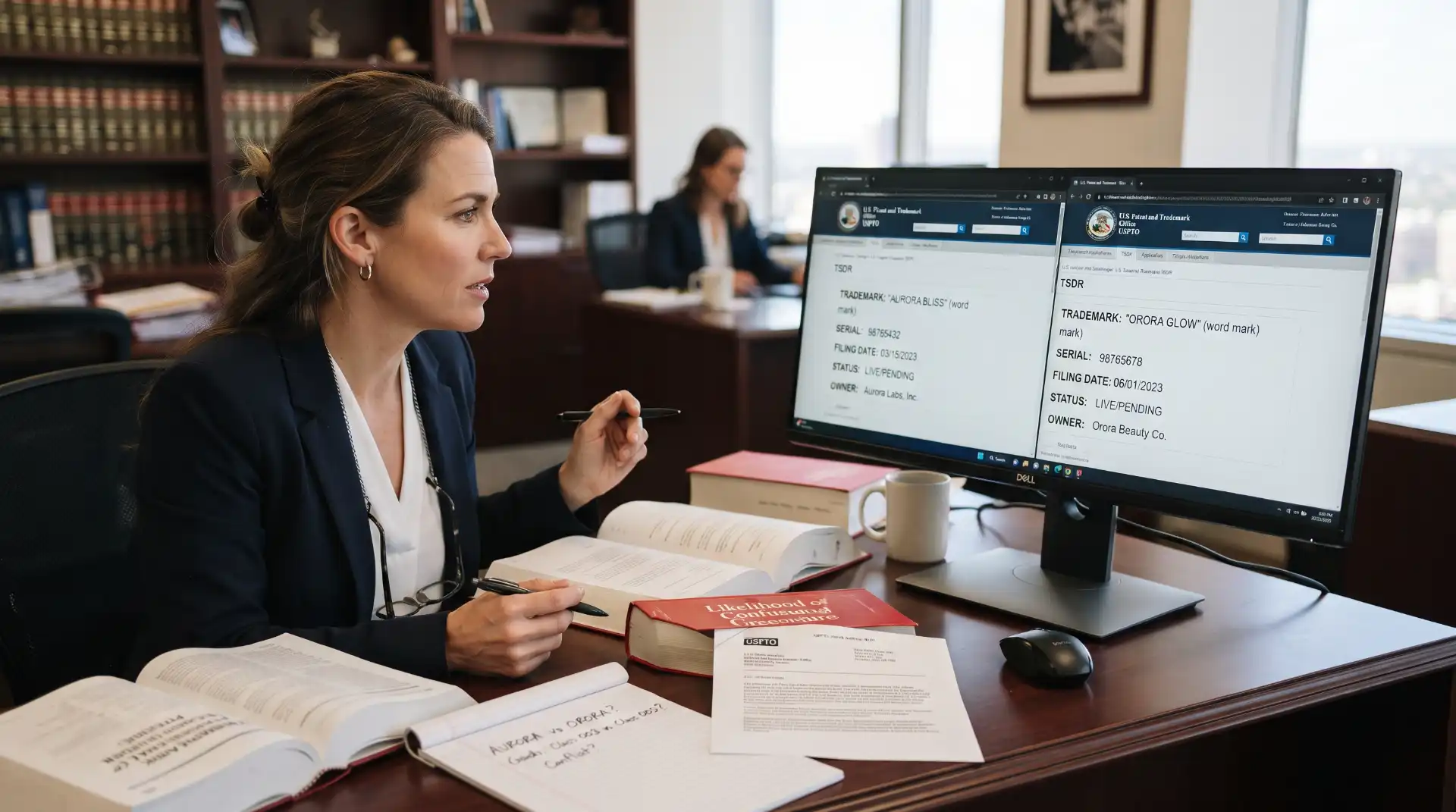
What Should a Business Do After Discovering a Suspicious Trademark Application?
The first step should generally be investigation rather than an immediate confrontation.
The business should identify the application number, applicant, filing date, claimed goods and services, filing basis, prosecution history, and current status.
It should then compare the application with its own trademark history and determine whether there is a genuine commercial conflict.
The company should also investigate the applicant’s apparent use of the mark. Does the applicant actually sell the listed products or services? Does the applicant operate a legitimate business? Is there evidence that the applicant knew about the existing brand?
Communications between the parties can also become important. If the applicant contacted the business and offered to sell the trademark at an unusually high price, the business should preserve those communications rather than deleting them.
Once the facts are assembled, the company can determine what legal options may be available.
Can a Business Oppose a Trademark Application?
Yes, in appropriate circumstances. A pending trademark application may be challenged through an opposition proceeding before the Trademark Trial and Appeal Board, commonly known as the TTAB.
The USPTO explains that trademark applications are published in the Official Gazette before registration. A party that believes it would be damaged by registration can generally file a notice of opposition within the applicable opposition period. The initial period is generally 30 days after publication, although extensions may be available under the applicable rules.
This deadline is one of the most important reasons businesses should monitor trademark filings.
If a company discovers a suspicious application but waits too long, it may lose the opportunity to challenge the application through the ordinary opposition process.
The exact deadline should always be confirmed through the USPTO’s current systems and rules because procedural requirements can change.
What Is a TTAB Opposition?
A TTAB opposition is an administrative proceeding in which a party seeks to prevent a trademark application from registering.
The party opposing the application must have an appropriate basis for the proceeding. Common issues can involve likelihood of confusion and other grounds recognized under federal trademark law.
The TTAB process involves pleadings, discovery, motions, evidence, testimony, and briefing. It is therefore more formal than simply sending an email to the trademark applicant.
A business should not assume that filing an opposition is equivalent to filing a lawsuit in federal court. The TTAB has a particular role in determining whether trademark applications and registrations should proceed through the federal registration system.
Businesses should understand what relief the proceeding can provide and whether additional legal action may be necessary.
What If the Squatter’s Trademark Has Already Registered?
The situation can become more complicated after registration, but a registered trademark is not necessarily immune from challenge.
Under appropriate circumstances, a party may petition the TTAB to cancel a registration. The USPTO provides procedures for initiating cancellation proceedings against existing trademark registrations.
The available grounds and timing can depend on the age of the registration and the specific facts. Certain grounds may become more limited after a registration has been in force for more than five years.
This makes early action particularly important. A company that discovers a potentially problematic registration should investigate its options rather than assuming the registration can simply be ignored.
Bad Faith and Intentional Misconduct
The phrase “bad faith” can be important in a trademark dispute, but businesses should use it carefully.
A person does not automatically act unlawfully merely because the person files a trademark application for a similar name. The legal significance of intent depends on the applicable claim and evidence.
Evidence of deliberate deception, knowingly false statements, intentional efforts to interfere with another company’s established rights, or other improper conduct can potentially become relevant to a dispute.
For example, suppose an applicant represents that it is using a trademark when the evidence indicates that the applicant never used the mark and filed the application primarily to obtain leverage over another company.
That factual situation can be very different from a business that independently selected a similar mark without knowing about the other company.
Businesses should therefore document facts supporting any allegation of bad faith rather than relying solely on suspicion.
Trademark Squatting and Domain Name Squatting
Trademark squatting and domain-name squatting are related but distinct issues.
Domain-name squatting generally involves registering or controlling an Internet domain associated with another party’s brand. Trademark squatting concerns rights in a trademark or service mark.
The two problems can overlap. A person may register a domain corresponding to a company’s brand and also attempt to register the corresponding trademark.
However, the legal procedures for addressing these problems are not necessarily the same.
Businesses should therefore evaluate domain-name disputes and trademark disputes separately while considering how the two problems affect the company’s overall brand strategy.
Trademark Squatting on Online Marketplaces
Online marketplaces have created another environment in which trademark disputes can develop quickly.
A seller may use a confusingly similar brand name, product packaging, or listing title. Customers may then believe that the seller is affiliated with the legitimate brand.
Businesses should preserve evidence when they encounter these situations. Screenshots, product listings, seller names, purchase records, photographs, communications, and marketplace URLs can help establish what occurred.
Evidence should ideally be preserved before the company begins a dispute because online listings can change or disappear.
Trademark owners should also understand the individual marketplace’s reporting and enforcement policies. Federal trademark rights and private platform policies are separate systems, even though they can sometimes work together.
Should You Send a Cease-and-Desist Letter?
A cease-and-desist letter can be an effective tool in some trademark disputes, particularly when the opposing party is willing to resolve the matter without formal litigation.
The letter may explain the company’s rights, identify the disputed conduct, request specific corrective action, and establish a deadline for response.
However, businesses should think strategically before sending one.
An aggressive letter can sometimes escalate a dispute. It may also encourage the opposing party to take defensive legal action or make counterclaims.
The appropriate approach depends on the strength of the company’s rights, the status of the trademark application, the opposing party’s conduct, and the commercial importance of the disputed brand.
For valuable trademarks, businesses should consider having experienced trademark counsel review the proposed communication.
Settlement Can Sometimes Be More Efficient Than Litigation
Not every trademark squatting dispute needs to become a lengthy legal proceeding.
In some situations, the parties may negotiate a resolution. The applicant may agree to abandon the application, transfer the mark, modify its branding, restrict its use, or enter into another arrangement.
A settlement can save time and expense when both parties have incentives to avoid prolonged litigation.
However, trademark settlements should be drafted carefully. A business may need to address trademark ownership, future use, geographic areas, goods and services, domain names, social media accounts, licensing rights, and enforcement obligations.
A poorly drafted settlement can simply move the dispute into another form.
Trademark Licensing Can Create Additional Risks
Businesses should also be careful when licensing trademarks to third parties.
A license can allow another company to use a trademark while ownership remains with the trademark owner. But the agreement should clearly define the permitted use and the standards that apply to the licensed brand.
Quality control can be particularly important in trademark licensing because consumers associate the mark with a particular source or level of quality.
Companies entering licensing relationships should therefore address permitted products, geographic scope, marketing standards, quality requirements, approval procedures, termination rights, and post-termination obligations.
These issues become even more important when a company is already dealing with unauthorized third-party use of the same or a similar mark.
International Brands Need a U.S. Trademark Strategy
International companies can be particularly vulnerable to trademark squatting because their brands may become well known before they establish a significant American presence.
A foreign company may have a valuable trademark in Europe, Asia, Latin America, or another region but have limited U.S. operations.
A third party may notice the brand’s international success and attempt to secure U.S. trademark rights.
International companies planning to enter the U.S. market should therefore consider trademark protection before a major commercial launch.
International trademark strategy can involve priority claims, foreign registrations, U.S. applications, treaties, and other considerations. Because these issues can be highly technical, international businesses should obtain advice tailored to their particular situation.
How Startups Can Reduce Trademark Squatting Risk
Startups often prioritize product development, fundraising, hiring, and customer acquisition. Intellectual-property planning can sometimes receive less attention during the early stages of the business.
That can be a costly mistake.
A startup should consider conducting trademark clearance research before committing substantial resources to a brand.
Once a name has been selected, the company should evaluate whether federal registration is appropriate and should maintain evidence showing how the mark is being used.
Founders should also determine which legal entity owns the trademark. If the company later creates subsidiaries or changes its corporate structure, ownership should be documented properly.
These steps can make a future trademark dispute easier to manage.
Trademark Squatting and the Broader IP Strategy
A company’s trademark is rarely its only intellectual-property asset.
Technology businesses may own patents, copyrights, trade secrets, trademarks, domain names, proprietary data, and contractual rights. Manufacturing businesses may have patents, product designs, brand names, confidential processes, and customer information.
That means trademark protection should be integrated into the company’s overall intellectual-property strategy.
For example, Legal Journal’s article on Cybersecurity and Intellectual Property: Protecting Trade Secrets From Data Breaches examines how companies can protect confidential information that may have substantial commercial value. This is relevant because businesses should understand that trademarks and trade secrets require different protection strategies even though both are valuable forms of intellectual property.
Similarly, Legal Journal’s coverage of Software Patents and Generative AI: What Developers and Companies Need to Know explains how technology businesses may need to evaluate multiple forms of IP protection rather than relying on a single legal right.
For companies involved in patent disputes, Legal Journal’s discussion of Google v. VirtaMove and the Future of PTAB Patent Challenges provides additional background on administrative patent proceedings and the broader role of the Patent Trial and Appeal Board in U.S. intellectual-property disputes.
These different areas of IP law demonstrate an important point: a company’s intellectual property should be managed as a portfolio rather than as a collection of unrelated legal issues.
Why Trademark Monitoring Should Be Ongoing
Filing a trademark application should not necessarily be the end of a company’s brand-protection efforts.
Businesses should continue monitoring new applications and marketplace activity involving important trademarks.
Monitoring can help identify potentially conflicting applications before they become registrations. It can also help businesses identify unauthorized commercial use, confusingly similar brands, counterfeit products, and other problems.
The purpose is not to challenge every application that resembles the company’s trademark. Excessive enforcement can become expensive and may not be commercially justified.
The goal should instead be to identify meaningful threats and address them proportionately.
What Evidence Can Help Prove a Trademark Squatting Problem?
Evidence can take many forms.
Businesses should preserve records showing their own use of the trademark, including dated advertisements, product packaging, invoices, website pages, catalogs, social media content, sales records, and promotional campaigns.
They should also preserve evidence involving the other party.
That can include communications, screenshots, trademark applications, marketplace listings, websites, domain registrations, product photographs, and statements made by the applicant.
If the applicant contacted the company about purchasing the trademark, the business should preserve the communication in its original form.
A pattern of conduct can sometimes be more informative than a single event.
For example, an applicant with numerous registrations corresponding to unrelated businesses may warrant closer investigation than an applicant operating a legitimate company under the disputed name.
Common Mistakes Businesses Make
One of the biggest mistakes is waiting too long.
Trademark disputes often have deadlines, and missing a deadline can limit the available options.
Another mistake is assuming that trademark ownership is determined solely by who owns a federal registration. Trademark rights can involve use, priority, registration, and other factors.
Businesses also sometimes assume that a slightly different spelling eliminates the risk of confusion. That is not necessarily the case.
A further mistake is failing to maintain evidence of trademark use. A company may remember that it launched a brand years earlier but struggle to prove exactly when and how the mark was used.
Finally, businesses sometimes confront a suspected squatter without first preserving evidence. Once the opposing party realizes that a dispute is developing, relevant online information may change.
How a Trademark Attorney Can Help
Trademark law can appear simple when reduced to the question of whether two names look alike. In practice, trademark disputes can involve detailed questions concerning priority, consumer confusion, ownership, filing status, evidence, deadlines, and available remedies.
A trademark attorney can help a business evaluate the strength of its position, investigate the opposing application or registration, identify potential legal grounds, and determine whether negotiation, opposition, cancellation, or litigation is appropriate.
Legal representation can be particularly valuable when the disputed trademark is connected to a major source of company revenue or a brand expansion strategy.
The TTAB process includes formal procedural requirements, and the USPTO emphasizes the importance of complying with applicable deadlines and filing requirements.

How Businesses Can Build a Stronger Trademark Protection Program
A strong trademark protection program does not need to be complicated for every business. It should, however, be consistent.
The company should maintain an inventory of important trademarks and determine which marks are registered, which are pending, and which are being used without registration.
It should maintain evidence of use and ownership and establish a process for reviewing potentially conflicting trademark applications.
Businesses should also coordinate trademark decisions with marketing and product-development teams. Marketing departments sometimes create new slogans, product names, or sub-brands without realizing that those identifiers may have legal significance.
Communication between business and legal teams can prevent unnecessary disputes before they begin.
What Businesses Should Do When a Trademark Squatter Demands Payment
A demand for money should not automatically be accepted or rejected without investigation.
The business should determine what rights the other party actually possesses, whether the registration or application is valid, whether the company has earlier rights, and what legal procedures are available.
The company should also preserve the demand and all related communications.
In some circumstances, negotiating a transfer may be commercially sensible. In other cases, paying the applicant could encourage additional demands or unnecessarily concede a position that the company could successfully challenge.
The correct response depends on the specific facts and should be evaluated before money or legal rights are exchanged.
The Role of the USPTO in Trademark Disputes
The USPTO administers the federal trademark registration system, while the TTAB handles particular administrative proceedings involving trademark applications and registrations.
The USPTO explains that the TTAB handles opposition and cancellation proceedings as well as other trademark matters. Businesses dealing with a suspicious filing should therefore consult the agency’s current resources rather than relying on outdated procedural information.
The official USPTO resources are particularly useful for checking application status, understanding filing procedures, identifying deadlines, and reviewing current TTAB requirements.
Frequently Asked Questions About Trademark Squatting
What is trademark squatting in the United States?
Trademark squatting generally refers to an attempt to obtain or control trademark rights in a brand or mark despite another party having a stronger legitimate connection to it. The term can cover several different factual situations and is not itself one specific federal legal claim.
Can I stop someone from registering my trademark?
Potentially. If the application is pending and has reached the opposition stage, an eligible party may be able to oppose the application before the TTAB. The appropriate grounds and deadlines depend on the specific circumstances.
How long do I have to oppose a trademark?
The initial opposition period is generally 30 days after publication, although extensions may be available. Businesses should check the official USPTO record immediately because the applicable deadline can be critical.
What if the squatter already has a trademark registration?
A registered trademark may still be subject to cancellation or other legal challenges in appropriate circumstances. The available grounds can depend on the age of the registration and the facts surrounding its procurement and use.
Does filing first automatically make someone the trademark owner?
No. Trademark rights can involve several factors, including use, priority, ownership, registration, and the nature of the goods or services. A business should not assume that the first filing automatically resolves every ownership issue.
Can a foreign company challenge a U.S. trademark squatter?
Potentially. Foreign companies may have different legal options depending on their U.S. activities, existing trademark rights, registrations, applications, international rights, and other circumstances. International businesses should obtain advice specific to their situation.
Is trademark squatting the same as domain-name squatting?
No. The two can overlap but involve different legal systems and procedures. Trademark squatting concerns trademark rights, while domain-name squatting concerns control or registration of Internet domain names.
Should a small business register its trademark?
Businesses should evaluate federal registration as part of their overall trademark strategy. Registration can provide important legal and practical benefits, although it does not eliminate every possible trademark dispute.
Conclusion: Early Action Can Protect a Valuable U.S. Brand
Trademark squatting can create serious problems for U.S. businesses because a brand often represents years of investment in customer recognition, marketing, reputation, and goodwill.
The most important lesson is that businesses should not wait until a disputed trademark becomes an emergency. Companies should conduct appropriate clearance research before major brand launches, consider federal registration, preserve evidence of trademark use, monitor important filings, and investigate suspicious applications promptly.
When a potentially bad-faith application appears, the company should first establish the facts. It should determine who filed the application, what goods and services are covered, when the filing occurred, whether the applicant appears to be using the mark, and what evidence exists concerning the company’s own trademark rights.
Depending on the circumstances, the business may have several possible strategies. These can include negotiation, opposition before the TTAB, cancellation of an existing registration, marketplace enforcement, or litigation.
The appropriate strategy will depend on the specific facts, the strength of the company’s rights, the status of the opposing trademark, and the commercial importance of the brand.
Trademark protection is also only one component of a larger intellectual-property strategy. Businesses may simultaneously need to protect patents, copyrights, trade secrets, domain names, licensing rights, and confidential information.
For companies that have invested heavily in building a recognizable U.S. brand, proactive trademark management can be far less disruptive than responding after another party has already established legal leverage.
Ultimately, trademark squatting is a problem best addressed through preparation. Businesses that monitor their brands, maintain strong records, understand trademark procedures, and respond promptly to suspicious filings are generally in a better position to protect the intellectual property they have worked to build.
Legal Disclaimer: This article is provided for general educational and informational purposes and does not constitute legal advice. Trademark rights, opposition procedures, cancellation proceedings, priority, likelihood of confusion, and available remedies depend on the specific facts and applicable law. Businesses facing a trademark dispute should consult a qualified U.S. trademark attorney regarding their particular circumstances.